Bartlesville requires a building permit for any structural alteration or reconstruction. Foundation work is not on the city’s short list of exempt finish jobs. Start with an on-site assessment by a repair company. It should tell you what is moving and which repair fits. It should also say which permit and fee it will cover in the quote.
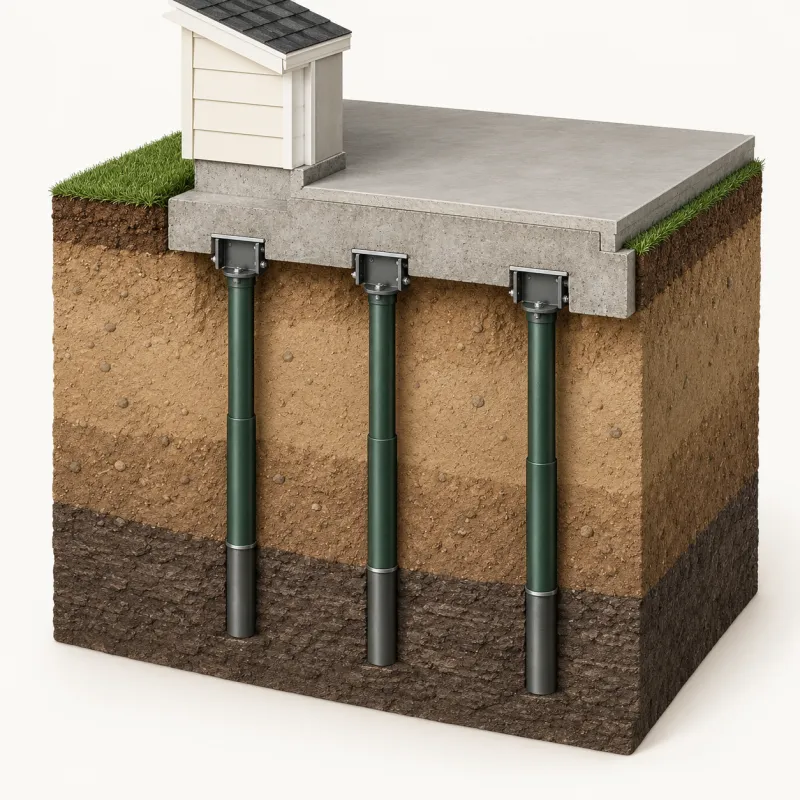
How the permit rule reads for pier work
The Building Services page lists what does not need a permit: painting, papering, tiling, carpeting, cabinets, countertops and similar finish work. Pier work is not finish work. Ask the company to confirm the permit it will pull and to include it in the bid.
As of October 2026, the city’s fee schedule lists a flat $50.00 for a residential remodel permit. That fee includes the first plan review and the floodplain determination, a check of whether the lot is in a flood zone. Ask the company to confirm whether the remodel fee applies to your repair and put the amount in the quote. The same schedule adds a penalty of 100% of the permit fee when work starts without a required permit. Settle the permit before you agree on a start date.
If your lot is near a creek, ask the company to check your address on the city’s GIS floodplain map. Any development activity in the floodplain needs a Flood Development permit from the Engineering Department. A company that already works in Bartlesville should be able to tell you whether your repair counts.
Washington County soil, past the headline figure
The facts list gives the county-wide share of high shrink-swell soil, the kind that swells when wet and shrinks as it dries. Three details in the same USDA data say more about how that clay behaves:
- Clay near the surface. About 7.0% of the county’s mapped land is rated high or very high in the top layer alone. In Oklahoma County, the same figure is 1.5%.
- Soils near the line. The largest high-rated unit is Dennis silt loam on 1–3% slopes, covering about 37,143 acres. Its linear extensibility, a measure of how much the soil swells, is 6.2%. That is just over the 6.0% mark where the survey’s “high” class begins.
- A very expansive flood-prone unit. Osage clay covers about 18,958 acres. The survey lists it on 0 to 1 percent slopes and “occasionally flooded”. It rates 12.1%, well into the very high class.
Clay that swells and shrinks this much is a reason to hire a company that already works on Bartlesville houses and knows these soils. Part of the city lies in Osage County; these Washington County estimates are not a test of your lot.
Houses built before 2000
About 86% of Bartlesville’s housing units were built before 2000. The Census estimate counts 16,672 units, and 14,292 of them were built before 2000. If you have any of these papers, give them to the company assessing the house now:
- earlier inspection reports
- pier records
- a previous company’s warranty papers
They help the company tell new movement from old.
Setting expectations for the repair
The ASCE Texas Section’s repair guideline, written for Texas engineers, is a useful yardstick. It cautions that lifting is unlikely to leave a foundation level, so be wary of a bid promising a flat floor. For major or whole-house repairs, the guideline says soil information should come from a site-specific boring and lab tests. A boring is a hole drilled to collect soil samples on your lot. For smaller jobs, the guideline allows local experience checked during construction. Ask each company which approach its plan used.
An independent structural engineer is worth paying for if bids disagree sharply or the damage is extensive. The same goes if a lender or buyer wants a report. The price table below uses national ranges from cost guides checked in October 2026.
Before you send the form
Use the form below to ask for an on-site look at your house. A useful quote names:
- the cause of the movement
- the number and type of piers
- any drainage work
- the permit the company will pull, with its fee
- whether a Flood Development permit is needed for your address
Local facts
- Bartlesville requires a building permit for any structural construction, alteration, demolition, remodel or reconstruction, and advises checking with Building Services before starting work. Building and Construction Services (City of Bartlesville Community Development)
- Half of Bartlesville's 16,672 homes were built in 1969 or earlier, and 69% were built before 1980. American Community Survey 5-year estimates 2020-2024, tables B25034 and B25035 (U.S. Census Bureau)
- About 43% of Washington County's mapped land has soils rated high or very high for shrink-swell (linear extensibility of 6% or more): clay that swells when wet and shrinks as it dries. Soil Data Access, SSURGO survey data (USDA NRCS)
Foundation repair prices (U.S. cost guides)
The overall range is $250–$30,000.
| Option | Low estimate | High estimate | Notes |
|---|---|---|---|
| Typical foundation repair, total | $2,225 | $8,133 | Angi (updated October 2026); Fixr gives a similar $2,200–$8,200. |
| Crack injection, per crack | $250 | $800 | HomeGuide (2025) and Angi. |
| Steel push pier, per pier | $1,000 | $3,000 | HomeGuide, Angi and Ram Jack cost pages. |
| Helical pier, per pier | $2,000 | $4,000 | HomeGuide (February 2026), Ram Jack; Angi about $3,000. |
| Underpinning, whole job (about 10 piers) | $10,000 | $30,000 | Angi (July 2026) and HomeGuide. |
| Drainage system | $2,800 | $6,500 | Angi (October 2026). |
| Structural engineer foundation inspection | $300 | $750 | HomeGuide (February 2026); Angi lists $300–$1,000 for a structural report. |
Usually included
- National averages from Angi, HomeGuide, Fixr and Ram Jack
Often extra
- City building permit, if your city requires one for the work
- Landscaping, interior drywall and trim repair after the foundation is stabilized
Questions to ask a repair company
For a major repair, or if the problem is unclear, will a licensed engineer review the plan?
Engineering guidelines describe an engineer's evaluation as the way to tell cosmetic cracks from structural damage. ASCE Texas Section guidelines (2022)
What is causing the movement, and what will be done about the water?
On shrink–swell clay, keeping soil moisture even around and under the foundation is the main way to reduce movement, so drainage and leaks matter as much as the repair. ASCE Geo-Institute, Living With Shrink/Swell Soils (2022)
Will the plumbing be tested after lifting, and who pays if a leak is found?
Engineering guidelines call for leak tests of water and sewer lines after a foundation is lifted. ASCE Texas Section guidelines (2022)
Will you measure floor levels before and after the repair?
Engineering guidelines call for an elevation survey after the work, which gives you a before-and-after record. ASCE Texas Section guidelines (2022)
Is the warranty in writing, what does it exclude, and does it transfer if I sell the house?
The FTC notes that a warranty won't necessarily cover all situations or repairs and advises getting spoken promises in writing. FTC, Warranties
Does this job need a city permit, and who will get it?
Oklahoma's Construction Industries Board tells homeowners to check whether a permit is needed and to see it before work begins. Oklahoma CIB, Home Repair Tips
Can I get three written estimates for the same plan?
Oklahoma's Construction Industries Board and Emergency Management recommend at least three estimates based on the same specifications. Oklahoma CIB, Home Repair Tips
Frequently asked questions
Do I need a permit for foundation repair in Bartlesville?
Bartlesville requires a building permit for any structural construction, alteration, remodel or reconstruction. The listed exemptions include finish work such as painting, tiling and cabinets. Ask the repair company to confirm the permit it will pull from Building Services for your job.
What will the permit cost?
As of October 2026, the city's fee schedule lists a flat $50.00 for a residential remodel permit. That fee includes the first plan review and the floodplain check. Ask the company to confirm which permit and fee apply to its plan. Request the permit charge as a separate line in that quote. Work started without a required permit adds a penalty equal to 100% of the permit fee.
Is expansive clay common around Bartlesville?
The USDA soil survey rates about 43% of Washington County's mapped land high or very high for shrink-swell, meaning soil that swells when wet and shrinks as it dries. About 7% is rated that way in the top soil layer alone.
Part of Bartlesville is in Osage County. Does that matter?
The state tax chart lists Bartlesville under both Washington and Osage counties. The soil figures on this page come from the Washington County survey. Tell the repair company which county your address is in.
Does a foundation repair company need a license in Oklahoma?
Foundation repair is not one of the trades the state Construction Industries Board licenses. Ask the company what local registration it holds and whether it has pulled permits in Bartlesville before.
Sources
- National Soil Survey Handbook
- Building and Construction Services (City of Bartlesville Community Development)
- Fee Schedule
- Flood Information
- Rates and Codes for Sales, Use, and Lodging Tax
- Frequently Asked Questions
- Soil Data Access, SSURGO survey data (USDA NRCS)
- American Community Survey 5-year estimates 2020-2024, tables B25034 and B25035 (U.S. Census Bureau)
- ASCE Texas Section Guidelines, Version 3 (2022)
- How Much Does Foundation Repair Cost? (Angi)
- How Much Does Underpinning a Foundation Cost? (Angi)
- Foundation Repair Cost (HomeGuide)
- Helical Piers Cost (HomeGuide)
- Foundation Crack Repair Cost (HomeGuide)
- Foundation Inspection Cost (HomeGuide)
- Cost to Repair a Foundation (Fixr)
- Cost of Foundation Repair (Ram Jack)