For a storm shelter in Seminole, plan the location and ask the installer to settle the permit before work starts. Once it is installed, use the city’s Map My Shelter form to record its location.
How the Map My Shelter form works
The city’s Emergency Management page links an online form called “Map My Shelter.” The Fire Department page and the city home page point to it too. It asks for:
- your name, address and phone numbers
- the shelter type: above ground, below ground or inside the house
- a pin on a map, placed as precisely as you can
- how many people the shelter holds
- a short note on where it sits on the property
The city says the answers are for emergency management only and are not public. Fill it in once the shelter is in, or ask the installer to do it as part of the job. The same page has a sign-up for emergency updates and recruits storm spotters.
Filing the building permit
Seminole’s permit page says building permits cover building, enlarging or altering a structure. Applications are taken in person at the Community Development Office. The application asks for the property owner, the location, the type of improvement, a drawing of it and its cost. As of October 2026, Seminole bases the permit price on the type of improvement.
The one-page form has lines for a plan review fee and a building permit fee. It also asks for a builder’s license number and the architect or engineer on the job. Building inspections are done by the city’s Code Enforcement team. Ask the installer to confirm the permit for your shelter and to put the fee in the written quote.
Wiring and the city’s contractor list
A light, an outlet or a vent fan in the shelter is electrical work. As of October 2026, electricians pay $200 a year to register with Seminole. They bring a copy of their state license and proof of liability insurance. The city’s “Are They Licensed” page lists registered contractors by trade, so you can look up the electrician named in a quote.
Tornadoes in Seminole County
Three tornadoes that crossed Seminole County were rated F4 along their full paths. They occurred on September 14, 1957, May 4, 1960 and May 17, 1981. Use the county chart below as background when comparing shelter options. The Seminole County storm shelter page has more on the county. For warnings, follow the National Weather Service and the city’s Emergency Management office.
Magnolia Creek and below-ground units
Magnolia Creek and its floodplains run through the middle of Seminole, according to the city’s 2012 long-range plan. That plan also records the city’s participation in the National Flood Insurance Program. Its Maps page links an online flood plain map. Look up your lot there before settling on a below-ground shelter. On a floodplain lot, SoonerSafe, the state rebate program, will not fund a below-ground unit. An above-ground safe room may still qualify.
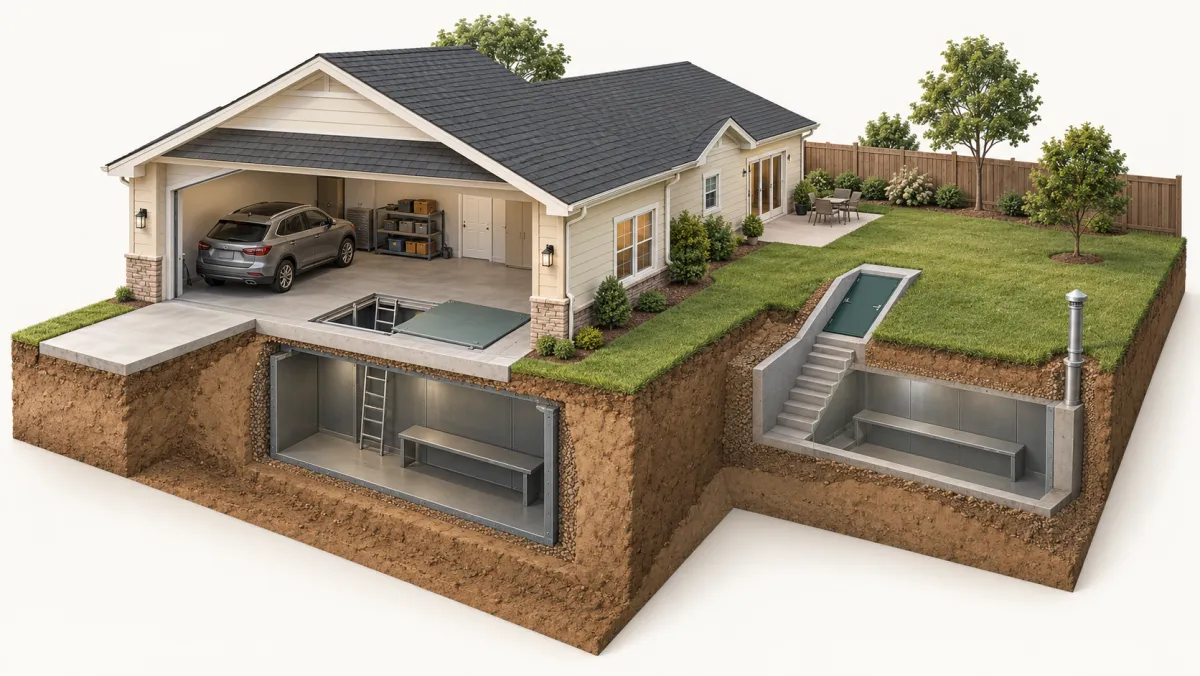
The Census estimates that only 395 Seminole housing units were built in 2000 or later. If you want a unit in the garage floor or bolted to the slab, ask how the installer will judge an old slab.
What to put in a Seminole quote request
Send the form below for a free quote from an installer who works in Seminole. Tell the installer which type you are leaning toward and whether your lot is near the creek. Ask for a quote that covers:
- an on-site look at the spot
- any permit needed, filed at Community Development, with its fee on a separate line
- the registered electrician, if the shelter gets wiring
- delivery, dirt haul-off and any pad or anchoring
- who fills in the Map My Shelter form
Local facts
- Seminole keeps a storm shelter registry so emergency teams can check after a disaster that families are not trapped in their shelters by debris. Emergency Management (City of Seminole)
- To register a Seminole shelter, use the city's online "Map My Shelter" form: give the shelter type, pin it on a map, and list its capacity. The data is not public. Storm Shelter Locations (City of Seminole, ArcGIS Survey123 form)
- Seminole building permits are applied for in person at the Community Development Office; the application asks for a drawing of the improvement and its cost. Building Permit (City of Seminole, Community Development)
- Seminole publishes an online list of city-licensed contractors by trade, including plumbers, electricians, mechanical contractors and roofers. Are They Licensed (City of Seminole, Code Enforcement)
- Seminole takes part in the National Flood Insurance Program, and the city's Maps page links an online flood plain map. Maps (City of Seminole, GIS)
- Half of Seminole's 3,091 homes were built in 1970 or earlier, and 67% were built before 1980. American Community Survey 5-year estimates 2020-2024, tables B25034 and B25035 (U.S. Census Bureau)
- NOAA's Storm Prediction Center records 63 tornadoes in Seminole County from 1950 through 2025; 12 of them were rated F3/EF3 or stronger. SPC Severe Weather Database: tornadoes 1950-2025 (NOAA Storm Prediction Center)
- 11 of those tornadoes happened in 2016–2025. SPC Severe Weather Database: tornadoes 1950-2025 (NOAA Storm Prediction Center)
- The deadliest tornado on record that touched Seminole County was the F4 of September 14, 1957, which killed 2 people along its full path. SPC Severe Weather Database: tornadoes 1950-2025 (NOAA Storm Prediction Center)
Storm shelter prices in Oklahoma
The overall range is $3,000–$15,000.
| Option | Low estimate | High estimate | Notes |
|---|---|---|---|
| Outdoor underground shelter, 6×8 to 7×10 ft, installed | $4,200 | $5,650 | Published 2026 price lists of two Oklahoma installers (Sprague's Backhoe, CM Construction). Digging and installation included; CM Construction does not state the shelter material. |
| Above-ground safe room for 9–16 people, installed | $6,250 | $8,000 | Same two Oklahoma installer price lists. Installation included. |
| Above-ground steel shelter for 4–16 people, unit only | $3,995 | $9,245 | Survive-a-Storm list prices (TwisterPod and Extreme). Installation not included; delivery extra; needs a concrete pad. |
| In-garage underground shelter, installed | $6,000 | $15,000 | National cost guides (HomeGuide, Angi). No Oklahoma installer publishes an installed price for this type. |
| Typical storm shelter project in Oklahoma | $3,000 | $8,000 | Angi's state range, updated September 2026. |
Usually included
- For the Oklahoma installer prices: the shelter, digging and installation (underground) or delivery, setting and anchoring (above-ground)
Often extra
- City permit: $34.50 in Moore, $54.50 in Norman, $88 (indoor) or $132 (outdoor) plus a state fee in Tulsa
- Dirt haul-off and delivery beyond the installer's service area
- A concrete pad for above-ground units, about $5–$10 per square foot (HomeGuide, 2024)
- Anchoring when billed separately, about $200–$350 (HomeGuide, 2024)
Questions to ask a shelter installer
Can you show written proof that this shelter and its door meet ICC 500 and FEMA P-361?
FEMA does not certify products and says a seller's claim of meeting these criteria should be backed by independent testing or engineering. FEMA P-320 (2021)
How will it be anchored, and is my slab strong enough for it?
FEMA notes that many prefabricated safe rooms end up on slabs without enough reinforcement, which undermines the protection they are built for. FEMA P-320 (2021)
Who gets the city permit, and can I see it before work starts?
Oklahoma's Construction Industries Board tells homeowners to see the building permit before letting work begin. Oklahoma CIB, Home Repair Tips
Will you register the shelter with the city, or should I?
FEMA advises registering the exact location of the entrance with local officials right after installation, so rescuers can find it if debris blocks the exit. FEMA P-320 (2021)
For a below-ground unit: is my lot in a flood zone, and how will water be kept out?
ICC 500 does not allow below-ground shelters in mapped flood hazard areas, and FEMA recommends a sump pump inside in-ground units. FEMA P-320 (2021)
If I want the SoonerSafe rebate, should I wait until I am selected?
SoonerSafe does not pay for a shelter installed before you are notified of selection, and the installer has to sign the certificate of installation. SoonerSafe FAQ (Oklahoma Emergency Management)
What is the payment schedule, and how much is due up front?
The FTC advises against paying the full amount up front and against making the final payment before the work is done. FTC, How To Avoid a Home Improvement Scam
Frequently asked questions
How do I register my storm shelter in Seminole?
Use the "Map My Shelter" link on the city's Emergency Management page. The form asks for the shelter type, a pin on a map, how many people it holds and where it sits on the property. The city says the information is for emergency management only and is not public.
Do I need a permit for a storm shelter in Seminole?
Ask your installer which permit your shelter needs under Seminole's general building rules. Have the company include the application and fee in its quote.
How much is the shelter permit in Seminole?
Seminole bases its permit charge on the improvement being made, as of October 2026. Ask the installer to confirm the fee and list it in the written quote.
Can I get the SoonerSafe rebate in Seminole?
Not right now. The SoonerSafe 2026 cycle remains closed as of October 2026. Seminole County was outside the 2025 priority area. In an open cycle, the rebate covers up to 75% of the cost, capped at $3,000, and only for a shelter installed after you are selected.
Does a shelter installer need a license in Seminole?
Shelter installation is outside the trades licensed by Oklahoma. Seminole does require electricians to register with the city. You can check a name on the city's "Are They Licensed" list.
Sources
- Emergency Management (City of Seminole)
- Storm Shelter Locations (City of Seminole, ArcGIS Survey123 form)
- Fire Department (City of Seminole)
- Building Permit (City of Seminole, Community Development)
- Download Permit PDF linked from "Building Permit" (City of Seminole)
- Code Enforcement (City of Seminole)
- Electrical Permit (City of Seminole)
- Are They Licensed (City of Seminole, Code Enforcement)
- Maps (City of Seminole, GIS)
- Seminole 2030 Comprehensive Plan (City of Seminole, April 2012)
- SoonerSafe Safe Room Rebate Program (Oklahoma Emergency Management)
- SoonerSafe Rules & Regulations (Oklahoma Emergency Management)
- SoonerSafe Frequently Asked Questions (Oklahoma Emergency Management)
- Frequently Asked Questions (Oklahoma Construction Industries Board)
- SPC Severe Weather Database: tornadoes 1950-2025 (NOAA Storm Prediction Center)
- American Community Survey 5-year estimates 2020-2024, tables B25034 and B25035 (U.S. Census Bureau)
- Oklahoma Below-Ground Storm Shelters (Sprague's Backhoe)
- Oklahoma Above-Ground Storm Shelters (Sprague's Backhoe)
- Storm Shelters (CM Construction)
- Residential Storm Shelters (Survive-a-Storm)
- How Much Does a Storm Shelter Cost? (Angi)
- Tornado & Storm Shelter Costs (HomeGuide)