A repair company should assess your Henryetta foundation before proposing a method or price. Have it plan the permit and work dates together, so the repair fits the city’s deadlines.
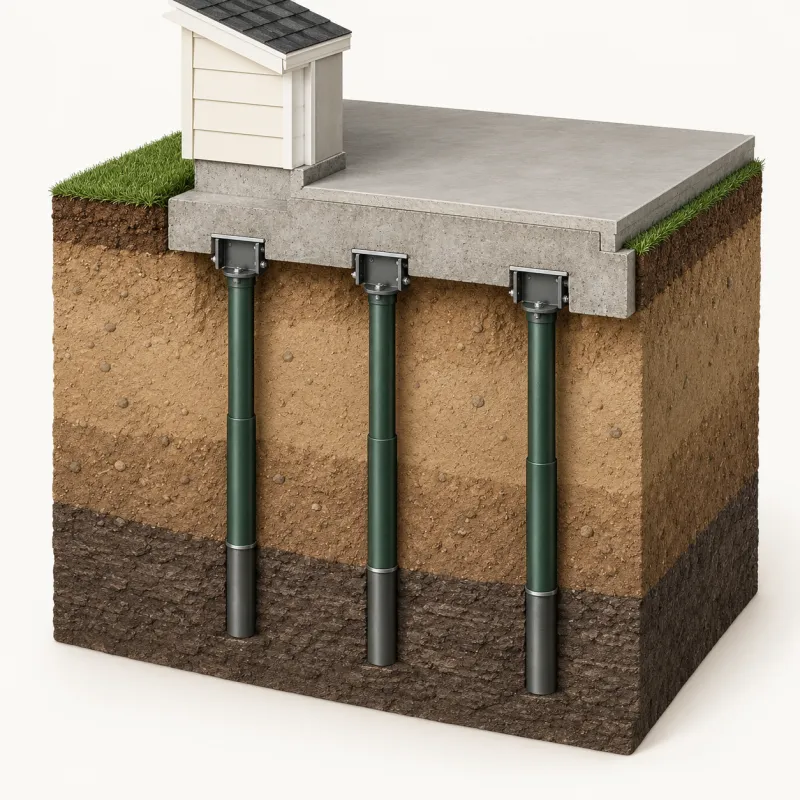
What Henryetta’s code says about repairs
The permit rule covers the “repair” of any building or structure in the city. The building code the city adopted also governs construction and repair of all buildings. Permits are bought before work starts, using the city’s written form. Code Enforcement issues them and handles building inspections.
The fee is set by the city council, based on estimated cost or another formula. The city clerk’s office keeps the fee schedule. Ask the company to confirm the permit it will file and to list the fee in the written quote.
A repair has to fit the permit window
Under a Henryetta permit, repairs must begin within 30 days and be completed within 30 days. The completion deadline can be extended by the city manager for good cause. Before you sign, ask the company:
- how many days the job will take;
- when it plans to file for the permit;
- what it will do if weather or a plumbing problem stretches the schedule.
The code makes the property owner and the contractor jointly responsible for getting the permit. A code violation can bring a fine of up to $500 for each day it continues. That is one more reason to settle the permit in the quote, not after it.
If the assessment finds a leak
A leaking water or sewer line can be part of a foundation problem. In Henryetta, plumbing permits are taken out by the contracting plumber, who pays the fee when applying. If plumbing is part of the repair, have the company identify the plumber and check the local requirements.
Okmulgee County soil layers
The USDA soil survey covers 449,401 mapped acres in Okmulgee County. It rates 31.2% of them high or very high for shrink-swell, meaning soil that swells when wet and shrinks as it dries. That share counts the most expansive layer starting within 60 inches of the surface. Rate the surface layer alone, and it drops to 0.8%. The very high class covers just 0.7%.
The largest high-rated soil is the Dennis silt loam on 1–3% slopes, at about 46,314 acres. Its estimated swelling measure, called linear extensibility, is 6.2%. The Taloka silt loam on 1–3% slopes adds 33,486 acres at 6.8%. Ask for an assessment from a company familiar with soil conditions around Henryetta. The county survey includes rural ground and cannot replace a check of your property.
Flood-zone houses
Henryetta’s flood rules can reach a big repair. In the mapped flood zone, a repair costing 50% or more of the building’s market value counts as a substantial improvement. Then the house must meet the flood rules for new construction. That means a lowest floor at least 1 ft above the base flood elevation, certified by an engineer, architect or land surveyor. Development in the flood zone also needs a permit from the City Manager. If your house is in the flood zone, ask the company to tell you early if its price comes near that 50% line.
Older homes and comparing bids
The Census estimates 261 Henryetta housing units were built in 2000 or later. Bring any old repair plans to the assessment and point out where symptoms have returned. For conflicting bids or extensive damage, consider an independent structural engineer’s review. The national guide prices below give you a starting point for comparing repair methods. Ask how any proposed piers, plumbing or drainage change the total.
Before you request a Henryetta quote
Request a Henryetta repair quote through the form below, starting with a look at your house. In the written quote, ask for:
- the cause of the movement;
- the repair method and any proposed pier count;
- the permit and its fee;
- the number of working days, so the job fits the 30-day window;
- any plumbing repair and who does it.
Local facts
- Henryetta's city code requires a permit before digging for, building or repairing any building or structure in the city. Henryetta Code of Ordinances, September 2026 (City of Henryetta)
- In Henryetta, the property owner and the contractor share responsibility for getting the permit; breaking the code can bring a fine of up to $500 for each day. Henryetta Code of Ordinances, September 2026 (City of Henryetta)
- Work under a Henryetta permit must start within 30 days and be finished within 30 days, or the permit becomes void, unless the city manager extends it. Henryetta Code of Ordinances, September 2026 (City of Henryetta)
- Building in Henryetta's flood zone needs a development permit from the City Manager: $100 application review, $25 permit fee and $25 per inspection. Henryetta Code of Ordinances, September 2026 (City of Henryetta)
- In Henryetta's flood zone, a new or substantially improved home's lowest floor, including a basement, must be at least 1 ft above the base flood elevation, certified by an engineer, architect or surveyor. Henryetta Code of Ordinances, September 2026 (City of Henryetta)
- In Henryetta's flood zone, a repair costing 50% or more of the building's market value must meet the flood rules for new construction. Henryetta Code of Ordinances, September 2026 (City of Henryetta)
- Half of Henryetta's 2,794 homes were built in 1964 or earlier, and 70% were built before 1980. American Community Survey 5-year estimates 2020-2024, tables B25034 and B25035 (U.S. Census Bureau)
- About 31% of Okmulgee County's mapped land has soils rated high or very high for shrink-swell (linear extensibility of 6% or more): clay that swells when wet and shrinks as it dries. Soil Data Access, SSURGO survey data (USDA NRCS)
Foundation repair prices (U.S. cost guides)
The overall range is $250–$30,000.
| Option | Low estimate | High estimate | Notes |
|---|---|---|---|
| Typical foundation repair, total | $2,225 | $8,133 | Angi (updated October 2026); Fixr gives a similar $2,200–$8,200. |
| Crack injection, per crack | $250 | $800 | HomeGuide (2025) and Angi. |
| Steel push pier, per pier | $1,000 | $3,000 | HomeGuide, Angi and Ram Jack cost pages. |
| Helical pier, per pier | $2,000 | $4,000 | HomeGuide (February 2026), Ram Jack; Angi about $3,000. |
| Underpinning, whole job (about 10 piers) | $10,000 | $30,000 | Angi (July 2026) and HomeGuide. |
| Drainage system | $2,800 | $6,500 | Angi (October 2026). |
| Structural engineer foundation inspection | $300 | $750 | HomeGuide (February 2026); Angi lists $300–$1,000 for a structural report. |
Usually included
- National averages from Angi, HomeGuide, Fixr and Ram Jack
Often extra
- City building permit, if your city requires one for the work
- Landscaping, interior drywall and trim repair after the foundation is stabilized
Questions to ask a repair company
For a major repair, or if the problem is unclear, will a licensed engineer review the plan?
Engineering guidelines describe an engineer's evaluation as the way to tell cosmetic cracks from structural damage. ASCE Texas Section guidelines (2022)
What is causing the movement, and what will be done about the water?
On shrink–swell clay, keeping soil moisture even around and under the foundation is the main way to reduce movement, so drainage and leaks matter as much as the repair. ASCE Geo-Institute, Living With Shrink/Swell Soils (2022)
Will the plumbing be tested after lifting, and who pays if a leak is found?
Engineering guidelines call for leak tests of water and sewer lines after a foundation is lifted. ASCE Texas Section guidelines (2022)
Will you measure floor levels before and after the repair?
Engineering guidelines call for an elevation survey after the work, which gives you a before-and-after record. ASCE Texas Section guidelines (2022)
Is the warranty in writing, what does it exclude, and does it transfer if I sell the house?
The FTC notes that a warranty won't necessarily cover all situations or repairs and advises getting spoken promises in writing. FTC, Warranties
Does this job need a city permit, and who will get it?
Oklahoma's Construction Industries Board tells homeowners to check whether a permit is needed and to see it before work begins. Oklahoma CIB, Home Repair Tips
Can I get three written estimates for the same plan?
Oklahoma's Construction Industries Board and Emergency Management recommend at least three estimates based on the same specifications. Oklahoma CIB, Home Repair Tips
Frequently asked questions
Do I need a permit for foundation repair in Henryetta?
Henryetta's code requires a permit before repairing any building or structure in the city. Code Enforcement issues the permits. Ask the company to confirm the permit it will file for its repair plan.
How much is a foundation repair permit in Henryetta?
The code bases permit fees on estimated cost or another formula set by the city council, and the schedule is kept at the city clerk's office. Have the company put the fee in its written quote.
What if the repair takes longer than 30 days?
A Henryetta permit becomes void if work does not start within 30 days or is not finished within 30 days. The completion deadline can be extended by the city manager for good cause. Ask the company how long the job will take before it files.
Is the soil around Henryetta expansive?
The USDA survey rates 31.2% of Okmulgee County's mapped land high or very high for shrink-swell. The surface-only share is 0.8%, which shows why deeper layers deserve attention in an assessment.
Does a foundation repair company need a license in Henryetta?
A foundation repair license is not among Oklahoma's state trade licenses. If the job includes plumbing, ask which plumber will pull that permit. Have the company check any local registration requirements for its work.
Sources
- Henryetta Code of Ordinances, September 2026 (City of Henryetta)
- Code Enforcement (City of Henryetta)
- Frequently Asked Questions (Oklahoma Construction Industries Board)
- Soil Data Access, SSURGO survey data (USDA NRCS)
- American Community Survey 5-year estimates 2020-2024, tables B25034 and B25035 (U.S. Census Bureau)
- How Much Does Foundation Repair Cost? (Angi)
- How Much Does Underpinning a Foundation Cost? (Angi)
- Foundation Repair Cost (HomeGuide)
- Helical Piers Cost (HomeGuide)
- Foundation Crack Repair Cost (HomeGuide)
- Foundation Inspection Cost (HomeGuide)
- Cost to Repair a Foundation (Fixr)
- Cost of Foundation Repair (Ram Jack)