The 2024 county hazard plan reports no expansive soils mapped in Choctaw. Start foundation repair here with a repair company’s on-site assessment of what is moving the house. It could be something like a leak or poor drainage. The repair itself goes through the Building Division, which issues permits for any construction, alteration or repair. Work may begin only after the permit is issued.
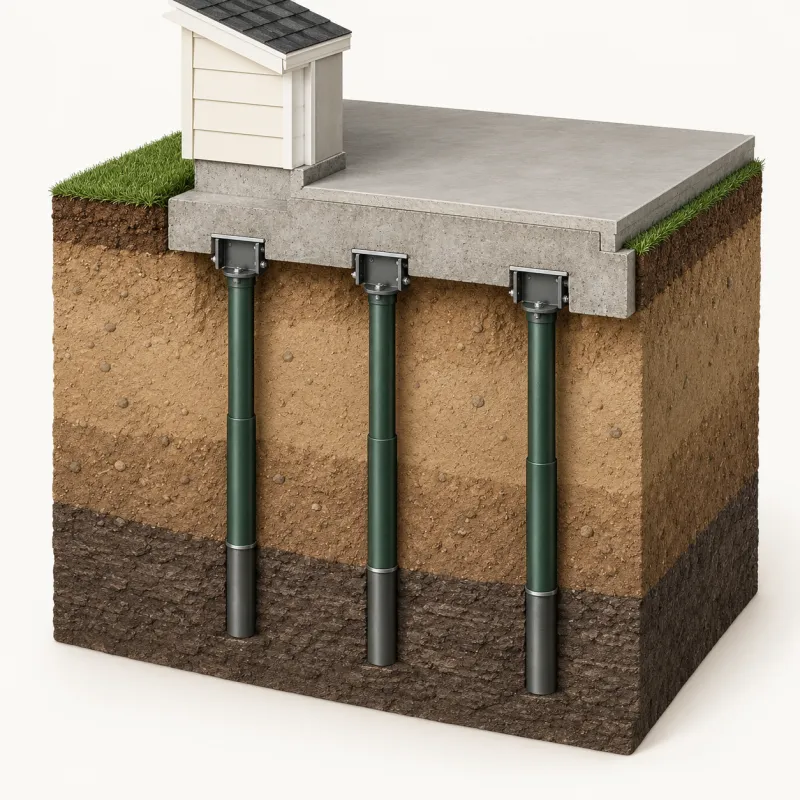
From application to foundation inspection
The city’s list of residential permit types has no separate repair or foundation entry. Ask the repair company which permit it will apply for. The steps after that are written down:
- Staff review the application and set the fee once it complies. They issue the permit when it is paid. The city prefers applications through its online portal and does not accept incomplete submissions.
- “Foundation” is one of the standard building inspections. Inspections need 24 hours’ notice and must be approved before work is covered. Missed ones may bring fees.
- A permit is valid for six months from issue. The building official can extend it on request.
- The city’s 2025 Residential Construction checklist asks for an Oklahoma-licensed engineer’s design for pier-and-grade-beam or post-tension foundations where they apply. That form covers new homes, remodels and additions. Ask the company whether its repair plan needs an engineer’s seal.
Why the cause matters more in Choctaw
The facts list puts two soil statements side by side. The county figure comes from a USDA calculation over 459,802 mapped acres, rural land included. Only 1.5% of the county is rated high or very high in the surface layer alone. The city finding comes from the county hazard plan. Put together, they mean you should not assume clay is to blame before someone has looked.
Water is the first thing worth ruling out. The Foundation Performance Association’s 2004 repair document, written for southeast Texas soils, lists what can make a lifted slab move again:
- broken sewer or water pipes under it
- trees growing close to it
- extreme seasonal swings
- poor drainage
The association’s 2012 drainage guideline adds one more. Air-conditioner condensate, the water the unit drips, can cause uneven soil pressure when discharged beside the foundation.
The ASCE Texas Section’s 2022 guideline is written for Texas engineers. It says a prudent approach may be to try drainage and watering fixes and watch how the foundation behaves, before or instead of structural repair. Ask each company whether a plumbing leak test or a drainage fix should come before piers on your house.
Flood-zone lots and the 10-year count
Choctaw Creek floods often enough to close State Highway 62. Building in a Choctaw floodplain needs a separate Floodplain Activity Permit. For work on an existing building, substantial improvement rules apply when its cost reaches 25% of the building’s market value. That test includes other construction costs over the last 10 years. Give the company records of earlier projects along with the house’s market value. As of October 2026, city documents list $75 and $120 for the floodplain permit. Ask the company to put the current amount in the quote.
Houses built since 2000
The ACS 2020–2024 estimate counts 1,416 Choctaw housing units built in 2000 or later. Whatever the age, original plans or past inspection reports help the company tell old movement from new. An independent structural engineer is worth adding if two bids disagree or the damage is extensive. The same goes if a lender wants a report. The table below gives national ranges from cost guides checked in October 2026.
The Choctaw quote request
ASCE Texas also says plans should state that piering will not improve the foundation in areas left without piers. Ask for that in writing.
The form below is the place to ask for an on-site look. A useful quote states:
- what is causing the movement
- any leak test or drainage work, and where it falls in the order of work
- the pier count and type
- the permit fee
Local facts
- Choctaw's Building Division issues permits for any construction, alteration or repair of a building; foundation repair is not named separately. Building Division Permits (City of Choctaw Development Services)
- The 2024 Oklahoma County Hazard Mitigation Plan does not list expansive soils as a hazard for Choctaw: per the NRCS soil map, no expansive soils are present in the city. Oklahoma County Hazard Mitigation Plan, 2024 Update, Section 9.4 City of Choctaw
- Choctaw Creek floods two to three times a year, closing State Highway 62 (NE 23rd) and forcing some evacuations, according to the 2024 county hazard mitigation plan. Oklahoma County Hazard Mitigation Plan, 2024 Update, Section 9.4 City of Choctaw
- Building in a Choctaw floodplain needs a separate Floodplain Activity Permit; a new structure's lowest floor must be at least 1 ft above the base flood level, and work on an existing building costing 25% or more of its market value (counting the last 10 years) falls under the substantial improvement rules. Floodplain Activity Permit Application (City of Choctaw, revised 2025)
- Half of Choctaw's 4,579 homes were built in 1983 or earlier, and 46% were built before 1980. American Community Survey 5-year estimates 2020-2024, tables B25034 and B25035 (U.S. Census Bureau)
- About 23% of Oklahoma County's mapped land has soils rated high or very high for shrink-swell (linear extensibility of 6% or more): clay that swells when wet and shrinks as it dries. Soil Data Access, SSURGO survey data (USDA NRCS)
Foundation repair prices (U.S. cost guides)
The overall range is $250–$30,000.
| Option | Low estimate | High estimate | Notes |
|---|---|---|---|
| Typical foundation repair, total | $2,225 | $8,133 | Angi (updated October 2026); Fixr gives a similar $2,200–$8,200. |
| Crack injection, per crack | $250 | $800 | HomeGuide (2025) and Angi. |
| Steel push pier, per pier | $1,000 | $3,000 | HomeGuide, Angi and Ram Jack cost pages. |
| Helical pier, per pier | $2,000 | $4,000 | HomeGuide (February 2026), Ram Jack; Angi about $3,000. |
| Underpinning, whole job (about 10 piers) | $10,000 | $30,000 | Angi (July 2026) and HomeGuide. |
| Drainage system | $2,800 | $6,500 | Angi (October 2026). |
| Structural engineer foundation inspection | $300 | $750 | HomeGuide (February 2026); Angi lists $300–$1,000 for a structural report. |
Usually included
- National averages from Angi, HomeGuide, Fixr and Ram Jack
Often extra
- City building permit, if your city requires one for the work
- Landscaping, interior drywall and trim repair after the foundation is stabilized
Questions to ask a repair company
For a major repair, or if the problem is unclear, will a licensed engineer review the plan?
Engineering guidelines describe an engineer's evaluation as the way to tell cosmetic cracks from structural damage. ASCE Texas Section guidelines (2022)
What is causing the movement, and what will be done about the water?
On shrink–swell clay, keeping soil moisture even around and under the foundation is the main way to reduce movement, so drainage and leaks matter as much as the repair. ASCE Geo-Institute, Living With Shrink/Swell Soils (2022)
Will the plumbing be tested after lifting, and who pays if a leak is found?
Engineering guidelines call for leak tests of water and sewer lines after a foundation is lifted. ASCE Texas Section guidelines (2022)
Will you measure floor levels before and after the repair?
Engineering guidelines call for an elevation survey after the work, which gives you a before-and-after record. ASCE Texas Section guidelines (2022)
Is the warranty in writing, what does it exclude, and does it transfer if I sell the house?
The FTC notes that a warranty won't necessarily cover all situations or repairs and advises getting spoken promises in writing. FTC, Warranties
Does this job need a city permit, and who will get it?
Oklahoma's Construction Industries Board tells homeowners to check whether a permit is needed and to see it before work begins. Oklahoma CIB, Home Repair Tips
Can I get three written estimates for the same plan?
Oklahoma's Construction Industries Board and Emergency Management recommend at least three estimates based on the same specifications. Oklahoma CIB, Home Repair Tips
Frequently asked questions
Do I need a permit for foundation repair in Choctaw?
Choctaw's Building Division issues permits and inspects any construction, alteration or repair of a building. Work may start only after the permit is issued. Ask the repair company which permit it will apply for and to show it in the quote.
How much does a foundation repair permit cost in Choctaw?
City staff set the fee once they find the application compliant. The permit is issued when it is paid. Ask the company to include the permit fee in its written quote.
Does Choctaw have expansive clay soil?
The 2024 Oklahoma County Hazard Mitigation Plan says that, per the NRCS soil map, no expansive soils are present in Choctaw. The 22.7% high or very high shrink-swell share in the USDA data covers Oklahoma County as a whole, including rural land.
My house is in a Choctaw floodplain. Does that change a foundation repair?
It can. Development in a designated floodplain needs a separate Floodplain Activity Permit. The substantial improvement rules also apply if the repair plus any other work in the last 10 years costs 25% or more of the building's market value. Ask the company to put the floodplain permit fee in the quote. Give it records of earlier work.
Does a foundation repair company need a license in Oklahoma?
There is no state license for foundation repair. The Construction Industries Board does not regulate it. Ask the company whether it holds any license or registration the City of Choctaw requires.
Sources
- Building Division Permits (City of Choctaw Development Services)
- Construction Policies and Procedures
- Residential Construction Submittal
- Floodplain Activity Permit Application (City of Choctaw, revised 2025)
- City of Choctaw - Choctaw Utilities Authority FY 2027 Fee Schedule — Development Fees
- Oklahoma County Hazard Mitigation Plan, 2024 Update, Section 9.4 City of Choctaw
- Soil Data Access, SSURGO survey data (USDA NRCS)
- American Community Survey 5-year estimates 2020-2024, tables B25034 and B25035 (U.S. Census Bureau)
- Frequently Asked Questions
- ASCE Texas Section Guidelines, Version 3 (2022)
- FPA-RC-01-0 (2004)
- FPA-SC-17-0 (2012)
- How Much Does Foundation Repair Cost? (Angi)
- How Much Does Underpinning a Foundation Cost? (Angi)
- Foundation Repair Cost (HomeGuide)
- Helical Piers Cost (HomeGuide)
- Foundation Crack Repair Cost (HomeGuide)
- Foundation Inspection Cost (HomeGuide)
- Cost to Repair a Foundation (Fixr)
- Cost of Foundation Repair (Ram Jack)