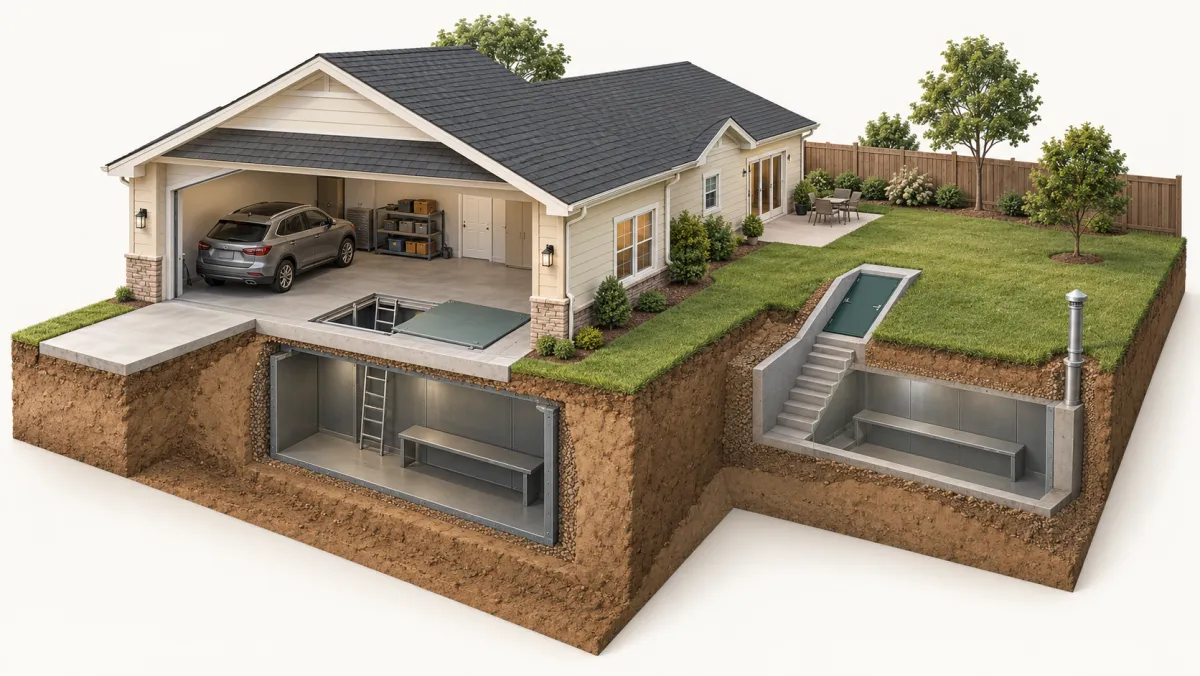
Tulsa permits storm shelters as two permit types of their own. As of October 2026 the city fee is a flat $88 for an indoor shelter and $132 for an outdoor one, plus a state fee. Both need engineered, stamped plans. A shelter in the yard also needs a grading and drainage plan and an erosion-control plan, so an outdoor job carries more paperwork.
What the Tulsa County record shows
The two deadliest tornadoes in the county record were both F4s. The June 8, 1974 tornado killed 14 people and injured 150 along its full path. The April 24, 1993 tornado killed 7 along its track. In 2016–2025 the county logged 23 tornadoes, none rated EF3 or stronger.
Two permits, two sets of plans
Tulsa’s Residential Site Plan Guidebook (January 2025) lists Indoor Storm Shelter and Outdoor Storm Shelter as separate residential permits. Ordinance No. 25351, approved in July 2024, sets the city fees:
| Permit | City fee | Plans with the application |
|---|---|---|
| Indoor storm shelter | $88 | Engineered, stamped plans |
| Outdoor storm shelter | $132 | Engineered, stamped plans, grading and drainage plan, erosion-control plan |
The fee is flat. The ordinance says no other administrative, zoning or watershed fees apply. The state building code fee is added on top. The city’s January 2025 newsletter also reminds residents to get a building permit for a safe room in a flood-prone area.
For a yard shelter, ask the installer to say in writing:
- whether it prepares the drainage and erosion plans, or you would hire someone else for them
- which of the two permit types it will file for your unit
A Tulsa installer who files these permits can also tell you how setbacks, garage placement and inspections are handled for your lot.
Who the city registry accepts
The City of Tulsa keeps a Storm Shelter Registry for emergency responders, with two conditions. The address must be inside Tulsa city limits, so homes in many Tulsa County suburbs fall outside it. And the safe room must meet FEMA P-320 or P-361 guidelines, FEMA’s safe room design guides. A basement counts only after an engineer certifies it. Registration is an online form linked from the city’s registration page.
Older houses, basements and cellars
Tulsa’s housing is older than Oklahoma City’s. Of its 192,797 homes, 166,601 (86%) were built before 2000, and 65% before 1980. If a house you own or are buying has a basement or an old cellar, the rules treat it differently from a new shelter.
- A basement can go on the city registry only with an engineer’s certification. SoonerSafe, the state rebate program, does not fund repairs or retrofits of existing shelters.
- An indoor safe room or in-garage shelter falls under the $88 permit if the city classifies it as indoor. For an underground garage unit, the table’s figure is a national guide range.
- An outdoor underground or above-ground unit in the yard takes the $132 permit and the drainage and erosion plans. If the lot is in a floodplain, SoonerSafe does not fund a below-ground safe room. It may fund an above-ground one.
What moves a Tulsa price
The Oklahoma installer prices in the table come from companies in the central and south-central part of the state. Those companies charge extra or stop serving past a set distance. A price from an installer that works in Tulsa is the one to budget on. Ask for these to be listed line by line:
- delivery
- dirt haul-off
- anchoring
- the stamped plans
- the outdoor drainage and erosion plans
- the $88 or $132 permit
Oklahoma has no state license for shelter installers, but any lights or outlets need a state-licensed electrician.
To get that kind of quote, use the form below. In the comment, say whether you have a basement, a garage or a yard spot in mind. Ask the installer to look at the spot, name the permit type, and price the plans, permit and installation together.
Local facts
- Starting work in Tulsa before getting a required permit adds a penalty fee of at least three times the regular permit fee. Ordinance No. 25351 – amending Title 49, Administrative, Permit and License Fees (City of Tulsa, 2024)
- Outdoor storm shelters in Tulsa also need grading, drainage and erosion-control plans with the permit application. Residential Site Plan Guidebook, January 2025 (City of Tulsa Development Services)
- Tulsa's storm shelter registry covers addresses inside city limits only, and a registered safe room must meet FEMA P-320 or P-361 guidelines (basements need an engineer's certification). Storm Shelter Registration (City of Tulsa)
- Half of Tulsa's 192,797 homes were built in 1973 or earlier, and 65% were built before 1980. American Community Survey 5-year estimates 2020-2024, tables B25034 and B25035 (U.S. Census Bureau)
- NOAA's Storm Prediction Center records 101 tornadoes in Tulsa County from 1950 through 2025; 10 of them were rated F3/EF3 or stronger. SPC Severe Weather Database: tornadoes 1950-2025 (NOAA Storm Prediction Center)
- 23 of those tornadoes happened in 2016–2025. SPC Severe Weather Database: tornadoes 1950-2025 (NOAA Storm Prediction Center)
- The deadliest tornado on record that touched Tulsa County was the F4 of June 8, 1974, which killed 14 people along its full path. SPC Severe Weather Database: tornadoes 1950-2025 (NOAA Storm Prediction Center)
Storm shelter prices in Oklahoma
The overall range is $3,000–$15,000.
| Option | Low estimate | High estimate | Notes |
|---|---|---|---|
| Outdoor underground shelter, 6×8 to 7×10 ft, installed | $4,200 | $5,650 | Published 2026 price lists of two Oklahoma installers (Sprague's Backhoe, CM Construction). Digging and installation included; CM Construction does not state the shelter material. |
| Above-ground safe room for 9–16 people, installed | $6,250 | $8,000 | Same two Oklahoma installer price lists. Installation included. |
| Above-ground steel shelter for 4–16 people, unit only | $3,995 | $9,245 | Survive-a-Storm list prices (TwisterPod and Extreme). Installation not included; delivery extra; needs a concrete pad. |
| In-garage underground shelter, installed | $6,000 | $15,000 | National cost guides (HomeGuide, Angi). No Oklahoma installer publishes an installed price for this type. |
| Typical storm shelter project in Oklahoma | $3,000 | $8,000 | Angi's state range, updated September 2026. |
Usually included
- For the Oklahoma installer prices: the shelter, digging and installation (underground) or delivery, setting and anchoring (above-ground)
Often extra
- City permit: $34.50 in Moore, $54.50 in Norman, $88 (indoor) or $132 (outdoor) plus a state fee in Tulsa
- Dirt haul-off and delivery beyond the installer's service area
- A concrete pad for above-ground units, about $5–$10 per square foot (HomeGuide, 2024)
- Anchoring when billed separately, about $200–$350 (HomeGuide, 2024)
Questions to ask a shelter installer
Can you show written proof that this shelter and its door meet ICC 500 and FEMA P-361?
FEMA does not certify products and says a seller's claim of meeting these criteria should be backed by independent testing or engineering. FEMA P-320 (2021)
How will it be anchored, and is my slab strong enough for it?
FEMA notes that many prefabricated safe rooms end up on slabs without enough reinforcement, which undermines the protection they are built for. FEMA P-320 (2021)
Who gets the city permit, and can I see it before work starts?
Oklahoma's Construction Industries Board tells homeowners to see the building permit before letting work begin. Oklahoma CIB, Home Repair Tips
Will you register the shelter with the city, or should I?
FEMA advises registering the exact location of the entrance with local officials right after installation, so rescuers can find it if debris blocks the exit. FEMA P-320 (2021)
For a below-ground unit: is my lot in a flood zone, and how will water be kept out?
ICC 500 does not allow below-ground shelters in mapped flood hazard areas, and FEMA recommends a sump pump inside in-ground units. FEMA P-320 (2021)
If I want the SoonerSafe rebate, should I wait until I am selected?
SoonerSafe does not pay for a shelter installed before you are notified of selection, and the installer has to sign the certificate of installation. SoonerSafe FAQ (Oklahoma Emergency Management)
What is the payment schedule, and how much is due up front?
The FTC advises against paying the full amount up front and against making the final payment before the work is done. FTC, How To Avoid a Home Improvement Scam
Frequently asked questions
What does a storm shelter permit cost in Tulsa?
As of October 2026, the city fee is a flat $88 for an indoor shelter and $132 for an outdoor one, plus a state building code fee. Ordinance No. 25351 (2024) sets these fees. The ordinance says no other administrative, zoning or watershed fees apply. Ask the installer to put the permit total in the written quote.
What extra plans does a backyard shelter need in Tulsa?
An outdoor storm shelter needs engineered, stamped plans like an indoor one. It also needs a grading and drainage plan and an erosion-control plan. This comes from the city's January 2025 Residential Site Plan Guidebook.
Can I register my basement as a safe room in Tulsa?
Only after an engineer certifies it. Tulsa's registry says a basement must be certified by an engineer before it counts as a safe room. Safe rooms must also meet FEMA P-320 or P-361 guidelines.
I live in a Tulsa suburb. Can I use the City of Tulsa registry?
No. The City of Tulsa registry is only for addresses inside Tulsa city limits. Ask your installer how to register a shelter at your suburban address.
Are there public tornado shelters in Tulsa?
Check Tulsa-area emergency management guidance for current public-shelter options. Plan where your household will go and follow National Weather Service warnings.
Can I get a SoonerSafe rebate in Tulsa right now?
No. Oklahoma Emergency Management reported in October 2026 that the 2026 cycle was not open. When a cycle runs, the rebate is up to $3,000 and capped at 75% of the cost. Only shelters installed after selection qualify.
Sources
- Ordinance No. 25351 – amending Title 49, Administrative, Permit and License Fees (City of Tulsa, 2024)
- Residential Site Plan Guidebook, January 2025 (City of Tulsa Development Services)
- City Life, January 2025 (City of Tulsa)
- Storm Shelter Registration (City of Tulsa)
- Reminder: No public shelters in Tulsa (KTUL)
- SoonerSafe Safe Room Rebate Program (Oklahoma Emergency Management)
- SoonerSafe Rules & Regulations (Oklahoma Emergency Management)
- SoonerSafe Frequently Asked Questions (Oklahoma Emergency Management)
- Frequently Asked Questions (Oklahoma Construction Industries Board)
- SPC tornado database 1950-2025, all tornadoes (NOAA Storm Prediction Center)
- ACS 5-year 2020-2024, table B25034 Year Structure Built (U.S. Census Bureau)
- Oklahoma Below-Ground Storm Shelters (Sprague's Backhoe)
- Oklahoma Above-Ground Storm Shelters (Sprague's Backhoe)
- Storm Shelters (CM Construction)
- Residential Storm Shelters (Survive-a-Storm)
- How Much Does a Storm Shelter Cost? (Angi)
- Tornado & Storm Shelter Costs (HomeGuide)
- American Community Survey 5-year estimates 2020-2024, tables B25034 and B25035 (U.S. Census Bureau)
- SPC Severe Weather Database: tornadoes 1950-2025 (NOAA Storm Prediction Center)