A Tulsa repair company can assess your foundation and propose a repair for the movement it finds. Ask it to explain the movement, recommend a repair and price the work with any permit included.
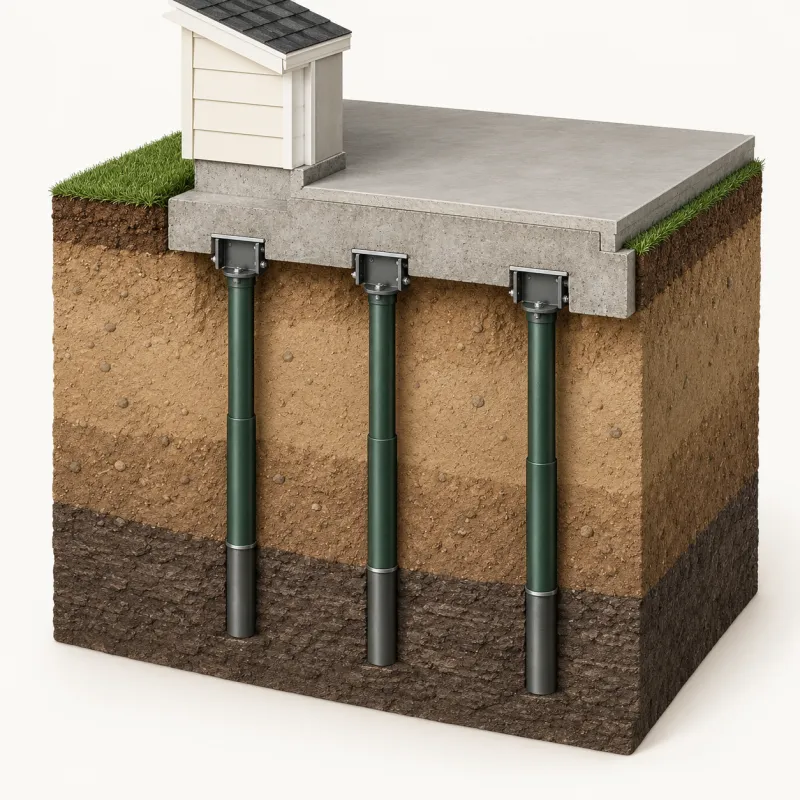
Repair or alteration: how Tulsa sorts the work
Tulsa’s permit information sheet, dated May 2026, draws the line. A repair fixes part of an existing building to maintain it or correct damage. Ordinary repairs need no permit, but that exemption excludes cutting or removing a structural beam or load-bearing support. Changing the roof or floor structure counts as an alteration and needs an alteration permit.
Have the repair company confirm how the city classifies your job. Two local steps matter when planning the work:
- “Repair No-Expansion” permits are applied for in person.
- If the damage is extensive or structural, construction plans are required.
The Permit Center issues general repair permits over the counter. Ask the company which permit it will file and whether it will need drawings for your house.
How the fee is figured
Tulsa sets building permit fees by the value of the work. The plans examiner decides that value, not only your own estimate. Plumbing, electrical and mechanical costs stay out of it. They go on separate trade permits taken out by licensed contractors. Have the company put the current permit fees in its quote.
Two timing rules matter. The 2024 ordinance adds a penalty for starting before a required permit is issued. An application that is not pursued is treated as abandoned after 180 days. As of October 2026, Tulsa’s planned adoption date for the 2024 building codes is January 1, 2027. Plans submitted after adoption must follow the new codes.
What the city’s own hazard plan says about clay
Tulsa’s 2024 hazard plan discusses expansive soils: ground that swells when wet and shrinks as it dries. It says Tulsa “is underlain by soils with very high expansion potential.” It adds that mitigation “may be required for building construction or repairs.” Large areas of central and east Tulsa have moderate to high shrink-swell potential. Lowlands along the river and waterways are generally low.
The plan lists the damage signs plainly: sticking doors, uneven floors, and cracks in foundations, floors, walls, ceilings and windows. “It does not take much movement to damage buildings,” it says. It counts 373 structures in Tulsa on soils with very high shrink-swell potential, worth an estimated $191 million. Damage comes with the seasons and follows cycles of drought and heavy rain. In extreme heat and drought, the same soils break City water lines.
The City treats soil damage to houses as a maintenance issue. Insurers do not track it as a natural hazard either. The foundation warning signs guide explains what each sign can mean.
Tulsa County soil figures
The USDA survey rates 39.3% of Tulsa County’s mapped land high or very high for shrink-swell. Very high ratings cover 5.4%. The largest high-rated unit is the Dennis silt loam on 1–3% slopes, at 27,583 acres. Its estimated shrink-swell measure is 6.2%, based on the soil survey. Ask a company familiar with Tulsa neighborhoods to assess the house, since county estimates are not a lot test.
Tulsa’s housing and your records
The Census survey estimates that 26,196 of Tulsa’s 192,797 housing units were built in 2000 or later. On an older house, there may be records of earlier work. Gather any old inspection reports, repair receipts or warranty papers before the visit.
If the damage is extensive or two companies propose very different fixes, an independent structural engineer can review the plans. The same applies when a lender, buyer or insurer asks for a report.
Floodplain addresses
In a Tulsa floodplain, a project costing 50 percent of the building’s value is a “substantial improvement.” The City says it may require raising or floodproofing the house. Any repair to a flood-damaged building needs a permit first. The City also advises re-grading the lot to keep water away from the house. If your home is in a mapped floodplain, ask the company to check the 50 percent line against its price.
Asking for a Tulsa quote
For a price comparison, the table gives national guide ranges checked in October 2026. Use the form below to request an on-site look from a company that works in Tulsa. Ask for a written quote that shows:
- the cause of the movement and the repair method
- whether the city will treat the job as a repair or an alteration
- any construction plans the plans examiner may want
- the permit fees at current rates
- any plumbing or drainage work, priced on its own line
Local facts
- Tulsa says ordinary repairs need no permit, but that does not cover cutting or removing a beam or load-bearing support; changing the floor structure needs an alteration permit. REPAIR or ALTERATION PERMITS (City of Tulsa Development Services, May 2026)
- Tulsa says a building permit is typically needed to repair walls or floors, and the Permit Center issues general repair permits over the counter. Plans Review (City of Tulsa Development Services)
- Starting work in Tulsa before getting a required permit adds a penalty fee of at least three times the regular permit fee. Ordinance No. 25351 – amending Title 49, Administrative, Permit and License Fees (City of Tulsa, 2024)
- Tulsa's 2024 hazard plan says large areas of central and east Tulsa have moderate to high shrink-swell soils, while lowlands along the river generally have low shrink-swell soils. 2024 Hazard Mitigation Plan (City of Tulsa)
- In a Tulsa floodplain, an improvement costing 50 percent of the building's value may require raising or floodproofing it, and repairs beyond storm cleanup need a permit. Flood Insurance (City of Tulsa, Water and Sewer – Flood Control)
- Half of Tulsa's 192,797 homes were built in 1973 or earlier, and 65% were built before 1980. American Community Survey 5-year estimates 2020-2024, tables B25034 and B25035 (U.S. Census Bureau)
- About 39% of Tulsa County's mapped land has soils rated high or very high for shrink-swell (linear extensibility of 6% or more): clay that swells when wet and shrinks as it dries. Soil Data Access, SSURGO survey data (USDA NRCS)
Foundation repair prices (U.S. cost guides)
The overall range is $250–$30,000.
| Option | Low estimate | High estimate | Notes |
|---|---|---|---|
| Typical foundation repair, total | $2,225 | $8,133 | Angi (updated October 2026); Fixr gives a similar $2,200–$8,200. |
| Crack injection, per crack | $250 | $800 | HomeGuide (2025) and Angi. |
| Steel push pier, per pier | $1,000 | $3,000 | HomeGuide, Angi and Ram Jack cost pages. |
| Helical pier, per pier | $2,000 | $4,000 | HomeGuide (February 2026), Ram Jack; Angi about $3,000. |
| Underpinning, whole job (about 10 piers) | $10,000 | $30,000 | Angi (July 2026) and HomeGuide. |
| Drainage system | $2,800 | $6,500 | Angi (October 2026). |
| Structural engineer foundation inspection | $300 | $750 | HomeGuide (February 2026); Angi lists $300–$1,000 for a structural report. |
Usually included
- National averages from Angi, HomeGuide, Fixr and Ram Jack
Often extra
- City building permit, if your city requires one for the work
- Landscaping, interior drywall and trim repair after the foundation is stabilized
Questions to ask a repair company
For a major repair, or if the problem is unclear, will a licensed engineer review the plan?
Engineering guidelines describe an engineer's evaluation as the way to tell cosmetic cracks from structural damage. ASCE Texas Section guidelines (2022)
What is causing the movement, and what will be done about the water?
On shrink–swell clay, keeping soil moisture even around and under the foundation is the main way to reduce movement, so drainage and leaks matter as much as the repair. ASCE Geo-Institute, Living With Shrink/Swell Soils (2022)
Will the plumbing be tested after lifting, and who pays if a leak is found?
Engineering guidelines call for leak tests of water and sewer lines after a foundation is lifted. ASCE Texas Section guidelines (2022)
Will you measure floor levels before and after the repair?
Engineering guidelines call for an elevation survey after the work, which gives you a before-and-after record. ASCE Texas Section guidelines (2022)
Is the warranty in writing, what does it exclude, and does it transfer if I sell the house?
The FTC notes that a warranty won't necessarily cover all situations or repairs and advises getting spoken promises in writing. FTC, Warranties
Does this job need a city permit, and who will get it?
Oklahoma's Construction Industries Board tells homeowners to check whether a permit is needed and to see it before work begins. Oklahoma CIB, Home Repair Tips
Can I get three written estimates for the same plan?
Oklahoma's Construction Industries Board and Emergency Management recommend at least three estimates based on the same specifications. Oklahoma CIB, Home Repair Tips
Frequently asked questions
Do I need a permit for foundation repair in Tulsa?
Ask the repair company to confirm the permit for your planned work before you agree to a start date. Have it explain how Tulsa classifies the job and include the permit fee in writing.
How is the permit fee set in Tulsa?
Tulsa bases the building permit fee on the value of the work. The city's plans examiner sets that value, not only the owner's estimate. Plumbing and electrical work go on their own trade permits. Ask the company to list each fee in the quote.
What happens if the work starts before the permit?
The city’s 2024 fee ordinance adds a penalty for starting work before a required permit is issued. Have the company settle the paperwork before work starts.
Is the soil in Tulsa expansive?
The City's 2024 hazard plan says Tulsa sits on soils with very high expansion potential. It says large areas of central and east Tulsa have moderate to high shrink-swell potential. Lowlands along the river and waterways generally have low shrink-swell soils.
Will Tulsa's code change affect my repair?
As of October 2026, Tulsa plans to adopt the 2024 building codes on January 1, 2027. Plans submitted after adoption must follow the new codes. If your plans go in around then, ask the company which version it is drawing them to.
Does a foundation repair company need a license in Oklahoma?
Oklahoma does not require a state license for general contractors. Ask the company to confirm any local requirements and identify the licensed tradespeople handling plumbing or electrical work.
Sources
- REPAIR or ALTERATION PERMITS (City of Tulsa Development Services, May 2026)
- Plans Review (City of Tulsa Development Services)
- Residential Site Plan Guidebook, January 2025 (City of Tulsa Development Services)
- City Life, January 2025 (City of Tulsa)
- Permit Center (City of Tulsa Development Services)
- Ordinance No. 25351 – amending Title 49, Administrative, Permit and License Fees (City of Tulsa, 2024)
- Residential Building Permit Process (City of Tulsa Development Services, 2019)
- 2024 Hazard Mitigation Plan (City of Tulsa)
- Flood Insurance (City of Tulsa, Water and Sewer – Flood Control)
- Know Your Risk of Flooding (City of Tulsa Engineering Services, floodplain brochure 2025)
- Frequently Asked Questions (Oklahoma Construction Industries Board)
- Soil Data Access, SSURGO survey data (USDA NRCS)
- American Community Survey 5-year estimates 2020-2024, tables B25034 and B25035 (U.S. Census Bureau)
- How Much Does Foundation Repair Cost? (Angi)
- How Much Does Underpinning a Foundation Cost? (Angi)
- Foundation Repair Cost (HomeGuide)
- Helical Piers Cost (HomeGuide)
- Foundation Crack Repair Cost (HomeGuide)
- Foundation Inspection Cost (HomeGuide)
- Cost to Repair a Foundation (Fixr)
- Cost of Foundation Repair (Ram Jack)