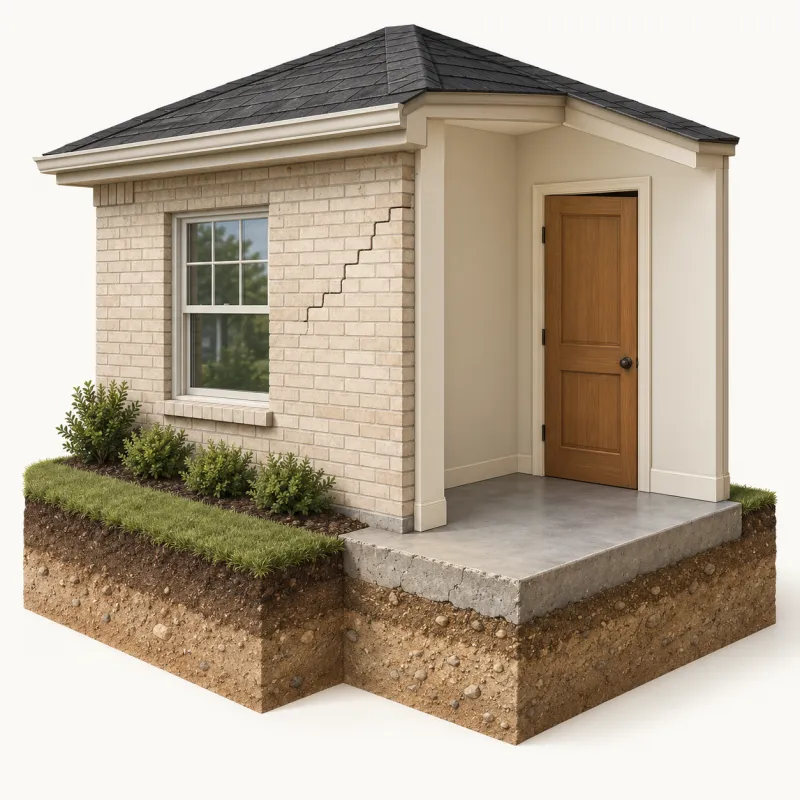
Changing cracks, sticking doors and sloping floors are signs to have a repair company assess. A gas smell or a section that appears unstable calls for immediate action. Stair-step cracks through brick are another sign to record and have checked.
| What you see | Level | Who to call |
|---|---|---|
| A single crack that is not changing | Watch and record | Date a photo; ask a repair company if you are unsure |
| Stair-step cracks in brick, sagging brick lines | Have it looked at | Foundation repair company |
| Several sticking doors or windows, gaps at frames | Have it looked at | Foundation repair company |
| A floor slope you can notice, bowed or leaning walls | Have it looked at | Foundation repair company |
| Water bill rising with no clear reason | Have it looked at | Leak detection plumber |
| Gas smell | Act now | Leave; gas utility and emergency services |
| Partial collapse or a section that appears unstable | Keep clear | Emergency services, then a structural engineer |
Why Oklahoma clay causes these symptoms
ASCE’s homeowner guide explains that shrink/swell clay moves foundations as its moisture changes. Drought, overwatering, leaks, roof runoff and tree roots can all make that moisture uneven around and under the house.
USDA survey estimates put high or very high shrink-swell soils at 39.3% of mapped acres in Tulsa County and 19.8% in Cleveland County. USDA says damage can begin at the moderate class. The county figures include rural land and are not a test of your lot, but they are one reason to pick a company that already works on local clay. Our Oklahoma foundation repair page has the county breakdown.
Level 1: watch and record
What it looks like. A hairline crack in drywall, a thin crack in the garage slab, a single door that sticks in one season.
What it can mean. Shrinkage and minor settling are possible causes. The ASCE Texas Section guideline is written for Texas engineers. It says most cracks do not compromise structural integrity, meaning they do not weaken the house. The 1987 Colorado geology guide describes curing and minor-settling cracks as about 1/8 inch or less.
What to do. Photograph the crack next to a tape measure and write the date on it. ASCE advises watching for progressive or seasonal movement. A crack that grows between seasons moves it up to level 2.
Level 2: have it looked at
What it looks like. ASCE’s homeowner guide lists these signs outside:
- masonry cracks;
- sagging brick lines;
- separating trim;
- tilting retaining walls;
- porches pulling away from the house.
Indoors, it lists cracks above doors, sticking windows and sloping floors. The Texas guideline says a tilt greater than 1 percent is usually noticeable. That is about 1/8 inch per foot.
What it can mean. On shrink/swell clay, possible causes include drought, overwatering and plumbing leaks. ASCE says the more signs you see, and the more often they show up, the more likely the foundation has moved.
What to do. Have a foundation repair company assess it. Ask what the visit found, which repairs the company recommends and what each would cost.
Level 3: act now
What it looks like. A gas smell. Or signs the Texas guideline ties to lost structural integrity, such as partial collapse, excessive sagging or badly deteriorated material.
What to do. If you smell gas, leave and call the gas utility and emergency services from outside. Keep people away from anything that appears unstable. Follow emergency services’ guidance.
Four checks you can do today
- Yard slope. ASCE says to check the ground within 10 feet of the house once a year. Soil should fall at least 3 inches over 5 feet, and preferably 6 inches over 10 feet.
- Downspouts. They should discharge at least 5 feet from the foundation, past planting beds, onto splash blocks.
- Drought watering. Follow city watering bans. During restrictions, ASCE suggests soaker hoses 18 inches from the foundation. It suggests more water on the south and west sides.
- Water bill. A jump with no clear reason can mean a hidden leak. That is a job for a leak detection plumber.
Repair company or structural engineer
A repair company’s assessment is the usual place to start. Ask the company to explain its findings and put any proposed repair and price in writing. The foundation repair cost page shows what the common repairs cost. As of October 2026, the Oklahoma Construction Industries Board has no foundation-repair license. So ask the company whether it is registered in your city.
An independent structural engineer fits these cases:
- a problem whose cause is unclear or disputed;
- conflicting bids;
- a report requested by your lender, buyer or insurer.
The Texas guideline describes what such evaluations cover: probable causes, the risk of further damage, repairs and estimated costs. HomeGuide’s December 2025 national guide lists $300–$750 for a structural engineer’s foundation inspection. Oklahoma law requires the roster of licensed professional engineers to be public. So you can check a license with the state board.
For level 2 signs, use the quote form to ask about a local assessment and written repair price. Bring your dated photos and ask who will handle any permit. Ask for these to be written into the quote:
- the cause it found;
- the repair it proposes;
- the drainage work.
Questions to ask a repair company
For a major repair, or if the problem is unclear, will a licensed engineer review the plan?
Engineering guidelines describe an engineer's evaluation as the way to tell cosmetic cracks from structural damage. ASCE Texas Section guidelines (2022)
What is causing the movement, and what will be done about the water?
On shrink–swell clay, keeping soil moisture even around and under the foundation is the main way to reduce movement, so drainage and leaks matter as much as the repair. ASCE Geo-Institute, Living With Shrink/Swell Soils (2022)
Will the plumbing be tested after lifting, and who pays if a leak is found?
Engineering guidelines call for leak tests of water and sewer lines after a foundation is lifted. ASCE Texas Section guidelines (2022)
Will you measure floor levels before and after the repair?
Engineering guidelines call for an elevation survey after the work, which gives you a before-and-after record. ASCE Texas Section guidelines (2022)
Is the warranty in writing, what does it exclude, and does it transfer if I sell the house?
The FTC notes that a warranty won't necessarily cover all situations or repairs and advises getting spoken promises in writing. FTC, Warranties
Does this job need a city permit, and who will get it?
Oklahoma's Construction Industries Board tells homeowners to check whether a permit is needed and to see it before work begins. Oklahoma CIB, Home Repair Tips
Can I get three written estimates for the same plan?
Oklahoma's Construction Industries Board and Emergency Management recommend at least three estimates based on the same specifications. Oklahoma CIB, Home Repair Tips
Frequently asked questions
Is every foundation crack a problem?
Check the crack's shape, whether it changes and whether other signs appear nearby. Take dated photos and share them with a repair company when you arrange an assessment.
How wide does a crack have to be before I get it checked?
Have a repair company look at a crack that keeps changing, whatever its width. The same goes for a crack that shows up together with sticking doors or a sloping floor.
My door started sticking. Does that mean the foundation moved?
It can. Swelling soil can distort door and window frames. But one door on its own is a sign to record. Several sticking doors plus cracks above them are worth having a repair company assess.
Should I call a repair company or a structural engineer first?
For most homes, a repair company's assessment is the normal first step. Ask for its findings, the recommended work and an itemized price. An independent structural engineer makes sense for a complex or disputed case. It also makes sense when two companies propose very different repairs, or when a lender, buyer or insurer wants a report. For inspection pricing, ask which findings and written report are included.
What should I do if I smell gas after noticing new cracks?
Leave the house first, then call your gas utility and emergency services from outside. Do not stay to look for the source. Cracks can wait; a gas smell cannot.
Sources
- Living With Shrink/Swell Soils — A Homeowners' Guide to Maintenance of Shallow Foundations, Version 2 (2022) (ASCE Geo-Institute)
- Guidelines for the Evaluation and Repair of Residential Foundations, Version 3 (2022) (ASCE Texas Section)
- Special Publication 14, Home Landscaping and Maintenance on Swelling Soil, 1987 (Colorado Geological Survey)
- Sections 475.11. - 475.12. (Oklahoma State Board of Licensure for Professional Engineers and Land Surveyors)
- Frequently Asked Questions (Oklahoma Construction Industries Board)
- Soil Data Access, SSURGO survey data (USDA NRCS)
- National Soil Survey Handbook, Part 618, section 618.42 Linear Extensibility Percent (USDA NRCS)
- How Much Does a Structural Engineer Cost? (2026) (HomeGuide)