Texas County’s record lists 76 tornadoes from 1950 through 2025 with no deaths anywhere along their paths. Before choosing a shelter site, ask the installer to check floodplain permits and standing water.
A Panhandle record
NOAA’s Storm Prediction Center lists 2 tornadoes rated F3/EF3 and none stronger. Each rating describes the strongest damage along the whole path. Eight tornadoes touched the county during 2016–2025, with none rated EF3 or stronger.
What the county plan says about shelter
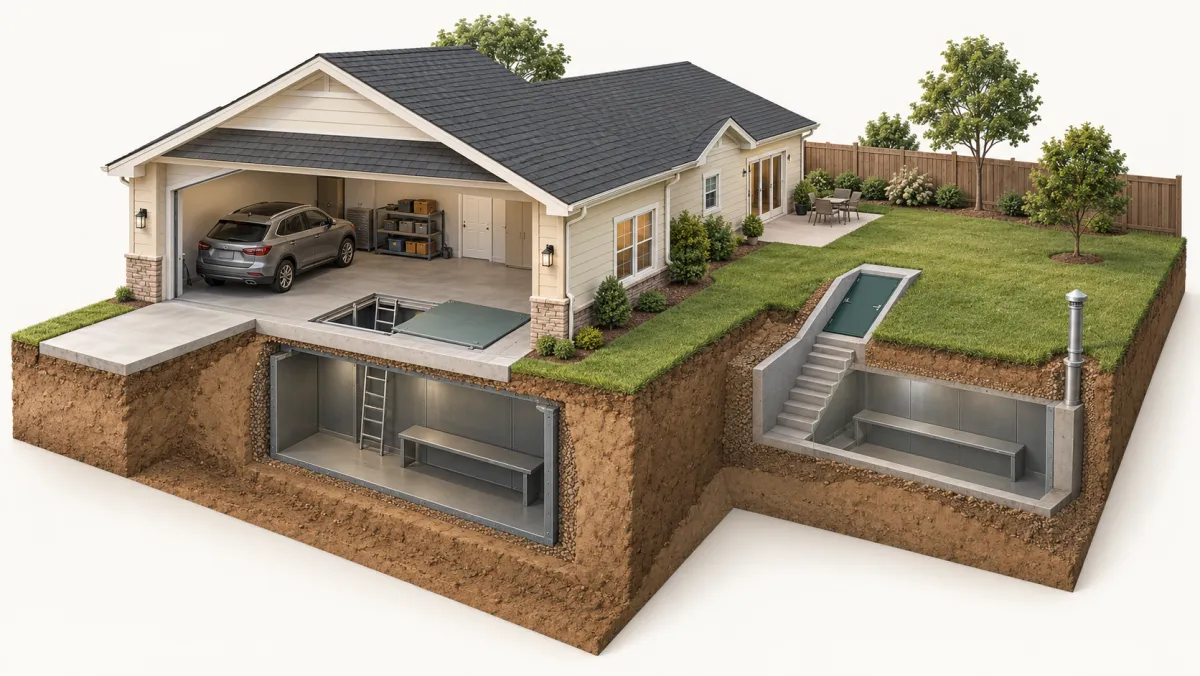
Texas County Emergency Management works from Guymon. Storm spotting and tornado alerts are county-wide duties, along with flood watches. Its Emergency Operations Plan advises residents to prepare shelter in or near the home. It cites liability and access after hours as reasons to avoid relying on government buildings. Follow county emergency management for current shelter guidance.
Digging in a floodplain
Texas County requires a permit for work in the floodplain. That includes building, digging, grading and drilling. The Emergency Management director is the county floodplain administrator. An in-ground shelter is digging, so the permit applies when your spot sits in a mapped floodplain. Ask the installer to check the flood map first and to show this permit as its own line in the quote.
For homes inside Guymon, see storm shelters in Guymon. For cracks or uneven floors, see foundation repair in Guymon.
Low spots with heavy clay
The soil survey covers 1,310,918 mapped acres in Texas County. High or very high shrink-swell soils cover 6.7% of that land. These soils swell when wet and shrink as they dry. The biggest high-rated soil is Sherm clay loam, 80,114 acres on 0–1% slopes. The very high ratings cover two soils: Ness clay, which is frequently ponded, and Lautz silty clay, which is occasionally ponded. Standing water and heavy clay are both worth raising with an installer before choosing an in-ground unit. Your own lot can differ from the county figures.
Shelter price ranges are on storm shelter costs in Oklahoma.
Requesting a free quote
Ask for a free quote and a visit to the spot you want to use. Tell the installer if water stands there after rain. Ask for a written quote showing:
- the shelter, with in-ground and above-ground prices if both fit
- the county floodplain permit or city permit, with its fee
- digging and dirt hauling
Frequently asked questions
Do I need a county permit to dig a shelter in the floodplain?
Texas County says floodplain work, including digging, needs a permit. The Emergency Management director serves as county floodplain administrator. Ask your installer to include that permit and its fee in the quote.
What about a shelter inside Guymon?
Guymon’s Building Department handles city building permits. See the linked Guymon shelter page for local steps. Ask the installer to confirm which permit it will pull for your address.
Should I count on a public building for tornado shelter?
The county's emergency plan advises against it. It tells residents to plan shelter in or near the home. The reasons it gives are liability and how hard it can be to get into a government building after business hours.
Is there a shelter rebate for Texas County homes?
As checked in October 2026, the state has not opened the 2026 SoonerSafe rebate round. When the program runs, it pays up to $3,000 per home and no more than 75% of the shelter's cost.
Sources
- SPC Severe Weather Database: tornadoes 1950-2025 (NOAA Storm Prediction Center)
- Soil Data Access, SSURGO survey data (USDA NRCS)
- Emergency Management (Texas County, Oklahoma)
- Texas County Emergency Operations Plan, Annex F, Appendix 1 "Tornado/Severe Weather Shelters" (Texas County, c. 2019)
- SoonerSafe Safe Room Rebate Program (Oklahoma Emergency Management)
- SoonerSafe Rules & Regulations (Oklahoma Emergency Management)
- Building Department (City of Guymon)