Start with a repair company visit to assess foundation movement and discuss repair options. You should come away with a written proposal naming the cause, the repair and an itemized price.
That paper is what you use to compare bids. So the visit is worth a little preparation.
Before the company arrives
A few things help the company read your house:
- dated photos of each crack, with a tape measure in the shot;
- a note of which doors or windows stick, and in which season;
- recent water bills, in case one jumped;
- where water pools after a heavy rain.
When you schedule, ask what the visit includes and whether there is any charge for it.
What to ask about during the visit
Cracks. ASCE’s homeowner guide lists the patterns that point to soil movement. Outside, these include stair-step cracks in brick and sagging brick lines. Inside, they include cracks above doors and windows. ASCE says the more signs there are, and the more often they show up, the more likely the foundation has moved.
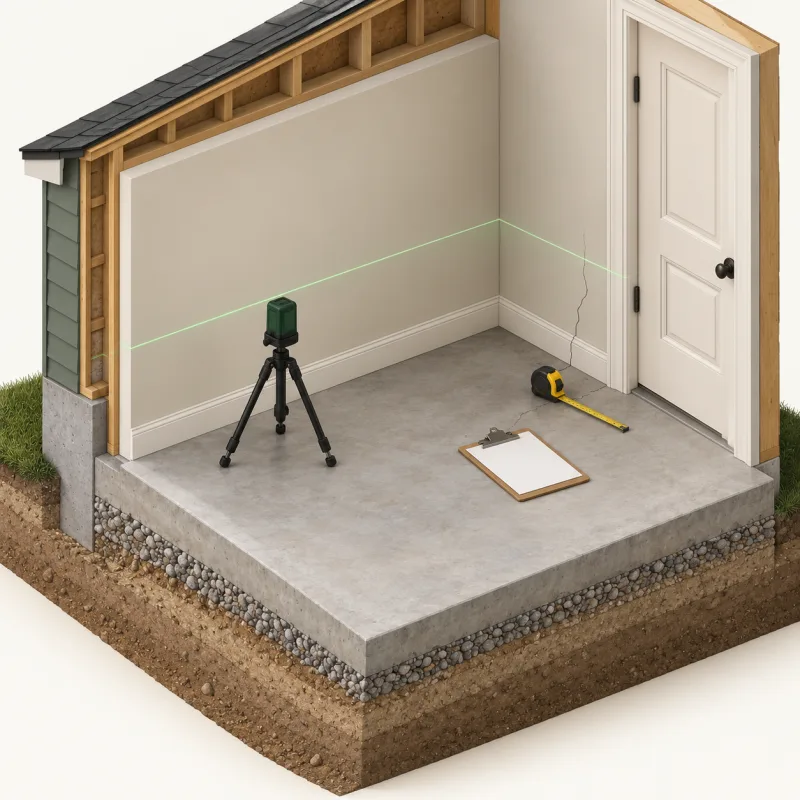
Floor levels. Ask what a slope means for your house. The ASCE Texas guideline, written for engineers, says a tilt over 1% is usually noticeable. That is about 1/8 inch per foot. Ask whether the visit includes floor measurements shown on a plan or just a walk-through.
Doors and windows. Sticking doors and gaps at frames can come from soil pushing upward. A 1987 Colorado state geology guide says wood that has not dried yet can cause similar damage. So one door alone is not a diagnosis.
Drainage. ASCE says the ground should slope away from the house and downspouts should empty well clear of it. A Houston repair association’s guideline says most repair systems need steady soil moisture and water directed away. Without that, the repaired slab can keep moving.
Plumbing. A leaking water or sewer line wets one spot under the house. ASCE points to a leak detection plumber for that.
What the written proposal should spell out
Use the ASCE Texas engineering guideline to help review the company’s proposal. Ask it to spell out:
- the cause it found, in plain words;
- the method, such as piers, slab lifting or crack injection;
- where each pier goes, how many, how deep and what they are made of;
- which parts of the house the repair covers;
- what result to expect;
- a leak test of water and sewer lines after any lifting;
- a floor-level survey after the work;
- any drainage work, and who does it;
- whether a permit is needed, and its fee if so.
Ask about the expected floor level, since ASCE says lifting is unlikely to leave a foundation perfectly level.
Then cover the contract basics. The Oklahoma Construction Industries Board tells homeowners to get a written contract with start and finish dates before work begins. The FTC says not to pay the full amount up front. It also says to get a salesperson’s spoken promises, including warranty terms, in writing.
How to compare bids
Oklahoma Emergency Management advises at least three estimates for major repairs, based on the same specifications. The CIB adds that the lowest estimate may not reflect the quality of materials.
Start with the diagnosis. If two companies name different causes, the prices are for different jobs. Then compare pier count, depth and price per pier line by line. Ask each company to confirm whether city registration is required and show you any registration it needs. The foundation repair cost guide shows typical prices for each method. The permit guide shows what cities ask for.
When an independent engineer makes sense
A repair company assessment is the starting point. Consider an independent structural engineer if:
- the problem is complex or the cause is disputed;
- the bids propose very different repairs;
- a lender, buyer or insurer wants a report.
Ask the engineer to explain the likely cause and the risk of more damage. The ASCE Texas guideline says an evaluation may also recommend repairs and estimate costs. The engineer can also design the repair. HomeGuide’s December 2025 national guide lists $300–$750 for a structural engineer’s foundation inspection. Ask what the inspection and any written report would include. Oklahoma law makes the roster of licensed engineers public, so you can check a license with the state board.
The warning signs guide helps you decide how soon to schedule a visit.
Asking for your first assessment
Request a visit through the quote form so a local repair company can assess the house and price its proposal. Share your photos and notes, and ask it to put these details in writing:
- the cause and the proposed method;
- the pier count and depth, or the area to be lifted;
- the drainage work;
- whether a permit is needed and how the company will handle it;
- the price, line by line.
Frequently asked questions
How long does an assessment take?
Ask when you schedule the visit. Ask too whether the company will measure floor levels or do a walk-through, since that changes what it can tell you.
Should I be home for the visit?
Yes, if you can. You know when doors started sticking, when cracks appeared and where water collects after rain. That history helps the company read what it sees.
What if the bids recommend different repairs?
Ask each company to explain its diagnosis and why its method fits. If the explanations still conflict, consider an independent structural engineer before choosing a repair.
Sources
- Living With Shrink/Swell Soils — A Homeowners' Guide to Maintenance of Shallow Foundations, Version 2 (2022) (ASCE Geo-Institute)
- Guidelines for the Evaluation and Repair of Residential Foundations, Version 3 (2022) (ASCE Texas Section)
- Special Publication 14, Home Landscaping and Maintenance on Swelling Soil, 1987 (Colorado Geological Survey)
- FPA-RC-01-0, Post Foundation Repair Performance of Residential and Other Low-Rise Buildings on Expansive Soils (Foundation Performance Association, 2004)
- Home Repair Tips
- Factsheet: Avoiding Post-Disaster Scams and Fraud
- How To Avoid a Home Improvement Scam
- Warranties
- Sections 475.11. - 475.12.
- How Much Does a Structural Engineer Cost? (2026)