A helical pier is a steel shaft with one or more screw-shaped plates. A hydraulic motor turns it into the ground like a large screw. It keeps turning until the resistance, read as torque (turning force), shows it can carry the planned load. A steel bracket then ties it to the footing. HomeGuide’s February 2026 national guide lists $2,000–$4,000 per pier installed. Because the pier is screwed in rather than pushed against the house, it does not depend on the house’s weight to go in.
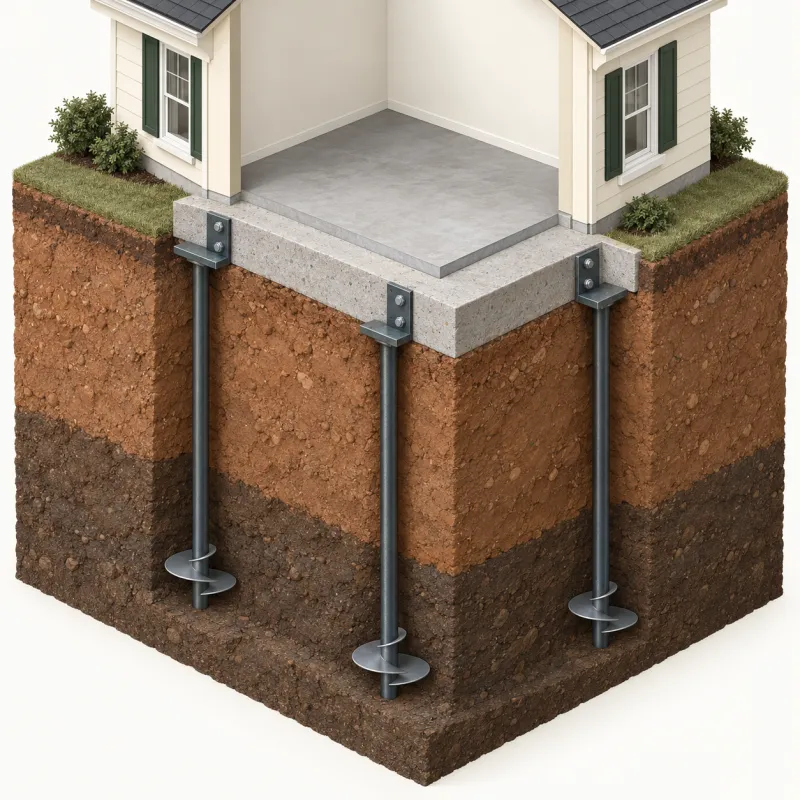
What a helical pier is made of
An ICC-ES evaluation report covers one product line, PierTech helical foundation systems. It describes the parts:
- a lead section with one or more helical steel plates;
- extension sections;
- couplings, the joints between sections;
- a bracket.
The shaft is turned into the ground. It is extended to the design depth or to a suitable bearing layer, firm ground that can carry the load.
How it attaches matters. On an existing house, the report says, a PierTech pile usually goes on a side bracket bolted against the footing. Side brackets carry only downward loads. Brackets that also resist uplift and sideways loads are cast into new concrete. That is new construction, not repair.
How installation torque verifies capacity
Under ESR-3969, a PierTech pile cannot be stopped at depth alone. Installation continues until the motor’s resistance reaches the torque the design calls for. Any minimum depth set by the soil report must also be met. In the report’s words, the pile “must be advanced until axial capacity is verified by achieving the required final installation torque.”
ESR-3969 gives these torque-correlation formulas for PierTech soil capacity. They use the final turning force to predict the load the soil can carry:
- Ultimate soil capacity (the predicted load limit of the soil) = torque factor × final installation torque.
- Allowable soil capacity (what the design may count on) = half the ultimate soil capacity, a safety factor of 2.
- For houses under the International Residential Code with no site-specific soil report, the safety factor rises to 2.5. The allowable soil capacity is then 40% of the ultimate.
The torque factor depends on the shaft. For one 2⅞-inch shaft in this report, it is 9 per foot in compression. Here is plain arithmetic, not a product rating. A final torque of 5,000 foot-pounds would predict 45,000 pounds of ultimate soil capacity. That gives 22,500 pounds allowable at a factor of 2, or 18,000 pounds at a factor of 2.5.
Torque is one of several checks. The allowable load is the lowest of four capacities: the bracket’s, the shaft’s, the helix plates’ and the soil’s. That rule comes from the building code section quoted in the report (IBC 1810.3.3.1.9). Soil capacity is found by calculation, torque or a load test.
Why helicals suit swelling clay
The CHANCE engineering manual comes from a maker of helical piles. It explains that the plates usually sit well below the seasonally moving clay. Only the thin shaft passes through that clay. A thin shaft gives swelling soil less to grip, so the upward force on it is small compared with larger piles. The ICC-ES report adds that the soil report should set any minimum depth for expansive soils. That is one reason soil testing may come before a large job.
Helical or push piers?
Steel push piers are driven with the house as the counterweight. The Foundation Performance Association’s 2004 Houston guide lists conditions where push piers are not suitable. One of them is “not enough weight to allow driving pile to the proper depth.” A helical pier is turned in by torque, so that weight does not limit it.
| Helical pier | Steel push pier | |
|---|---|---|
| How it goes in | Turned in by a hydraulic motor | Pushed in, using the house as counterweight |
| Capacity record described in the reports | PierTech: final torque and a tested factor | CHANCE: hydraulic force logged per section |
| National price per pier | $2,000–$4,000 | $1,000–$3,000 |
The repair company that assesses the house proposes a system and a layout. For a major job or conflicting proposals, an independent engineer can help compare the designs and soil data. The ASCE Texas Section wrote its 2022 guideline for engineers practicing in Texas. For major remedial work, it recommends site-specific boring and testing, meaning soil is drilled and tested at your lot.
Installation in the field
From the ICC-ES report for PierTech piles:
- Dig beside the footing at each location. The hole is about 18 inches wide and about 12 inches below the bottom of the footing.
- Clean the footing face. Do not notch the footing or cut reinforcing steel without approval from the engineer and the code official.
- Attach the lead section to the motor. Press the tip in at the planned spot and angle. Turn it steadily, about 3 inches of advance per turn.
- Add extensions until the required torque and depth are reached. This product must stay within 1 degree of vertical.
- Fit the bracket. Lift with a jack to the target height and tighten. Remove the jacks and backfill.
The report says any lift “must be verified by a registered design professional” and approved by the code official. Under the report’s cited International Building Code provisions, special inspection runs continuously during installation. Among other items, it records:
- the installer’s certification by the manufacturer;
- the torque;
- the final depth;
- each pile’s tilt and position.
The report uses a 50-year corrosion allowance for the shaft properties used in its ratings. It excludes corrosive ground, such as soil with a pH below 5.5, landfill or mine waste. The report cites AC358, “Helical Pile Systems and Devices,” dated June 2020 and editorially revised March 2021. Ask the company to confirm the permit it will pull and the inspection records the city will want. Ask it to include both in the written quote.
Common pitfalls, and what helicals don’t fix
The 2004 FPA guide lists four failure causes:
- piers spaced too far apart and overloaded;
- piers installed at the wrong angle;
- piers not turned to the proper torque and depth below the active zone (the moving clay layer), which lets them move with the seasons;
- brackets poorly anchored to the beam, which lets the connection slip.
The ASCE Texas guideline gives general underpinning guidance. It says work under one area does not improve the unsupported areas. It describes a level foundation after lifting as unlikely. Piers also do not replace drainage work. Where practicable, the same guideline recommends ground sloping at least 5% (6 inches in 10 feet) away from the house for the first 10 feet. It also says downspouts should not be connected to perforated drain pipe. If you are still sorting out whether your cracks need attention, start with our page on foundation warning signs.
What helical piers cost
The helical row in the table below is $2,000–$4,000 per pier. It comes from HomeGuide (February 2026) and Ram Jack, with Angi at about $3,000. HomeGuide puts 10 piers at $20,000–$40,000. It adds $20–$25 or more per foot when piers must go deeper than planned. These are national cost-guide figures; the foundation repair cost page covers how to compare quotes.
Request a helical-pier quote to arrange an assessment and discuss a written price. Ask who will handle any required permit, and get these on separate lines:
- the pier count;
- the target torque;
- the planned depth;
- the per-foot charge beyond it.
Foundation repair prices (U.S. cost guides)
The overall range is $250–$30,000.
| Option | Low estimate | High estimate | Notes |
|---|---|---|---|
| Typical foundation repair, total | $2,225 | $8,133 | Angi (updated October 2026); Fixr gives a similar $2,200–$8,200. |
| Crack injection, per crack | $250 | $800 | HomeGuide (2025) and Angi. |
| Steel push pier, per pier | $1,000 | $3,000 | HomeGuide, Angi and Ram Jack cost pages. |
| Helical pier, per pier | $2,000 | $4,000 | HomeGuide (February 2026), Ram Jack; Angi about $3,000. |
| Underpinning, whole job (about 10 piers) | $10,000 | $30,000 | Angi (July 2026) and HomeGuide. |
| Drainage system | $2,800 | $6,500 | Angi (October 2026). |
| Structural engineer foundation inspection | $300 | $750 | HomeGuide (February 2026); Angi lists $300–$1,000 for a structural report. |
Usually included
- National averages from Angi, HomeGuide, Fixr and Ram Jack
Often extra
- City building permit, if your city requires one for the work
- Landscaping, interior drywall and trim repair after the foundation is stabilized
Frequently asked questions
What does the torque reading on a helical pier tell you?
It predicts how much load the pier can carry in that soil. For PierTech piles in ICC-ES ESR-3969, final torque multiplied by the shaft's correlation factor gives the ultimate soil capacity. The allowable soil capacity is half that. For houses under the residential code without a site-specific soil report, it is 40%. Bracket, shaft and helix capacities also limit the allowable load.
When are helical piers chosen over steel push piers?
Push piers need the weight of the house to drive them. A Houston repair guide from the Foundation Performance Association lists a house too light to drive the pier to proper depth as a poor fit for them. Helical piers are screwed in, so they do not depend on that weight. The company that assesses your house proposes the system. If the job is complex or bids disagree, ask an independent engineer to review the proposed systems.
Can helical piers hold my house down if the clay swells?
Ask which PierTech bracket is proposed. ESR-3969 describes side brackets for existing foundations and brackets cast into new concrete for new construction. Have the designer confirm whether that connection is designed for uplift.
How much does a helical pier cost?
National guides put it at $2,000–$4,000 per pier installed. HomeGuide (February 2026) says most people spend about $3,000 per pier. It gives $20,000–$40,000 for 10 piers. It adds $20–$25 or more per foot when piers go deeper than planned.
What paperwork should I get after installation?
The installation records for every pier. ICC-ES ESR-3969 for PierTech calls for continuous special inspection under its cited International Building Code provisions. That inspection records torque, final depth, tip elevation, tilt and position. Ask the company to name who keeps those records and to give you a copy when the job is done.
Sources
- PierTech Helical Foundation Systems — ESR-3969 (ICC Evaluation Service, reissued January 2026)
- AC358 (24) - Helical Pile Systems and Devices (ICC Evaluation Service, published April 2025)
- Technical Design Manual (Hubbell Power Systems / CHANCE, Edition 3, 2014)
- Post Foundation Repair Performance of Residential and Other Low-Rise Buildings on Expansive Soils (Foundation Performance Association, FPA-RC-01-0, 2004)
- Guidelines for the Evaluation and Repair of Residential Foundations (ASCE Texas Section, Version 3, 2022)
- Helical Piers Cost (HomeGuide)
- How Much Does Underpinning a Foundation Cost? (Angi)
- How Much Does Foundation Repair Cost? (Angi)
- Foundation Repair Cost (HomeGuide)
- Foundation Crack Repair Cost (HomeGuide)
- Foundation Inspection Cost (HomeGuide)
- Cost to Repair a Foundation (Fixr)
- Cost of Foundation Repair (Ram Jack)