Check the door, vents, drainage and supplies as part of your storm shelter upkeep. Follow the maker’s inspection schedule, and use this checklist to prepare before storm season.
After the shelter is installed
Look for the sign. ICC 500 requires a sign inside every storm shelter, as FEMA P-320 (2021) explains. It must state:
- the design capacity, meaning how many people the room is built for
- the storm type (tornado)
- the design wind speed, 250 mph for home safe rooms
- the ICC 500 edition used
- the maker or builder
Keep the documents together. The NSSA’s inspector program lists the papers an inspection looks at. These include product listings, the special inspection statement, installation instructions and the maintenance manual. Store them where you keep the house papers, not inside the shelter.
Register the entrance. Debris can block the exit after a storm. FEMA P-320 (2021) says to tell local emergency managers and the fire department where your shelter is, right after it is built. Oklahoma City, Tulsa and Norman run shelter registries. See the shelter registration guide for local registration steps. For an NSSA-sealed shelter, the association also keeps its location and seal number.
Claim the property tax exemption. Oklahoma exempts up to 100 square feet of a shelter added after January 1, 2002 from property tax. Under the rules checked in October 2026, file OTC 905 with your county assessor by March 15 for that tax year. You must own the property on January 1. A transfer of ownership ends the exemption.
Learn the door. Survive-a-Storm’s care manual tells owners to get used to opening and closing the door before they need it in a hurry. Have each person who will use the shelter try it.
Watch the ground around a yard shelter. Survive-a-Storm says the ground around its buried steel Estate model can take 2–4 good rains to settle. Look at the soil and the entrance after the first heavy rains.
A checklist for routine checks
Door or hatch
- Open and close it from inside and outside. The latch should work smoothly.
- Make sure any outside handle still locks out. FEMA P-361 (2021) explains why: debris hitting a handle should not be able to open the door.
- Check that the tools for opening the door from inside are still there.
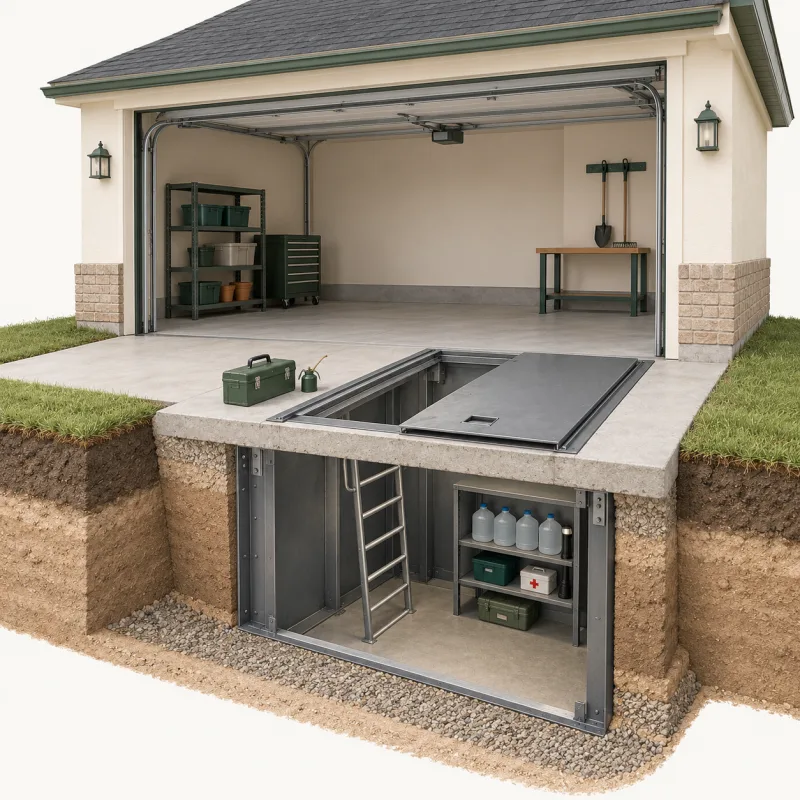
- For a garage hatch, check that nothing is parked or stored on it. FEMA P-320 (2021) names a parked car as an obstacle to plan around.
Vents
Look at every vent from inside and outside and clear anything blocking it. Survive-a-Storm’s manual says never to cover the vents while the shelter is in use. FEMA’s plans also warn people not to sit under vent pipes that point down.
Water
- FEMA P-320 (2021) says the ground should slope away from the entrance, so check that it still does.
- FEMA recommends a sump pump inside in-ground shelters. If yours has one, run it to see that it works.
- For a garage unit, think about where water from a leaking water heater would go. FEMA recommends a design that keeps it out.
Survive-a-Storm’s above-ground manual says to keep water directed away from the shelter. It warns that water piling up against it can cause damage its warranty does not cover.
The way out
Look up as well as around. The NSSA warns that trees, power poles and power lines can fall and block a shelter. Keep a canned air horn or whistle inside, and bring a phone each time.
Supplies and lighting
Use the supply-kit checklist in the size guide. Try the flashlights and radios, then check that spare batteries and chargers are ready.
FEMA P-320 (2021) says to replace expired items and update the kit as your family changes. Keep food in a cool, dry place, with anything not canned in closed plastic or metal containers.
Storage
Clear out anything that has crept in. The NSSA says nothing should be stored there that cannot be cleared quickly, even by a child. Survive-a-Storm’s manual adds two rules: no fuel or flammable materials inside, and no open flame.
When a check turns something up
Have the installer or maker check a sticking door, water inside or a damaged vent. Ask it to follow the tested door design when replacing parts. If the household has outgrown the shelter, the size guide shows how to count space.
For a replacement or a new shelter, request an itemized installed price through the free quote form. Tell the installer about any problems with the existing unit. Ask it to include permit handling and registration arrangements in writing. The shelter standards guide covers the documents to request.
Frequently asked questions
Should the shelter be kept locked?
Survive-a-Storm's care manual says to lock it when it is not in use. It also says to keep the key somewhere easy to reach, so you are not locked out during a storm. Everyone who may use the shelter should know where the key is.
Can I fix a sticking door or a leak myself?
Ask the maker or installer to check the problem before changing parts. FEMA P-361 (2021) says door changes need a new review by the certifying agency. Whether retesting is needed depends on that review.
Does FEMA inspect existing shelters?
No. FEMA P-320 (2021) says FEMA does not provide inspection services. Your local building official can help check that a shelter sits properly on an adequate foundation. The NSSA also runs a Certified Inspector credential that covers home tornado shelters.
Do I have to renew the tax exemption each year?
Oklahoma Tax Commission rules say no annual application is needed once the exemption has been granted.
Sources
- FEMA P-320, "Taking Shelter from the Storm: Building or Installing a Safe Room for Your Home", Fifth Edition, March 2021
- FEMA P-361, "Safe Rooms for Tornadoes and Hurricanes: Guidance for Community and Residential Safe Rooms", Fourth Edition, April 2021
- Homeowner Information
- NSSA Certified Inspector
- Product Use and Care Manual for Above Ground Shelters
- Estate Installation Instructions
- Storm Shelter Registry
- Storm Shelter Registration
- Storm Shelter Registration
- Oklahoma Constitution – Article X – Revenue and Taxation
- OAC 710:10, Chapter 10. Ad Valorem, Subchapter 6 "Storm Shelter Exemption" (Oklahoma Tax Commission, 2026 rules PDF)