FEMA P-361 gives safe-room design guidance, and ICC 500 sets storm shelter standards. The NSSA seal adds an optional review by a trade group. Ask the maker and installer for documents showing how the exact model meets those criteria.
Three names, three different jobs
FEMA P-361 is FEMA’s design guide for safe rooms. A room built to it gives “near-absolute protection” from wind and flying debris, in FEMA’s words. FEMA P-320 (2021), its homeowner guide, says home safe rooms are designed for 250 mph winds wherever the house is.
ICC 500 is the building-code standard for storm shelters. It sets the tests a shelter and its door must pass, and the labels that show they passed.
The NSSA seal comes from the National Storm Shelter Association, a trade group of shelter producers. A third-party registered engineer reviews the shelter documents. If they pass, the NSSA issues a seal for each installed shelter. The association also keeps each sealed shelter’s location and seal number, so it can be found after a storm.
Checking a seller’s claim
Look for test reports that back up a claim of meeting FEMA P-361 and ICC 500 criteria. Ask for proof from independent testing or engineering analysis, as FEMA P-320 (2021) advises, since FEMA does not certify products.
How shelters and doors are tested
The test missile is a 15-pound 2x4 board. FEMA explains why. A 250 mph wind can throw that board sideways at 100 mph, and that is enough to punch through most home building materials. For a home safe room, FEMA P-361 (2021) sets these test speeds:
- vertical surfaces, including walls and doors: 100 mph
- horizontal surfaces: 67 mph
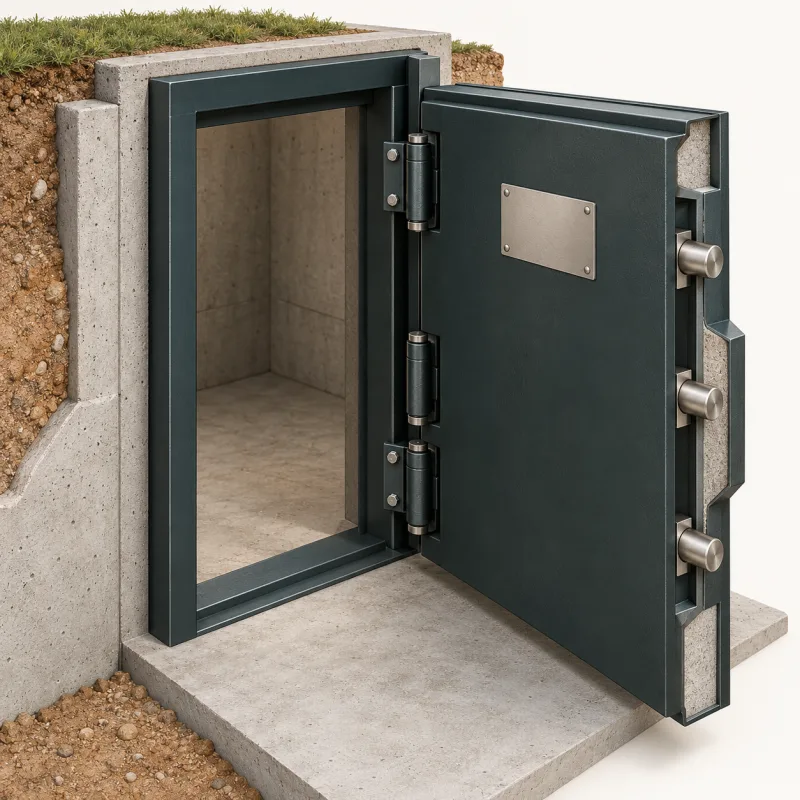
The door is tested as a complete assembly. Its hardware and frame anchors are part of that test. It is pushed and pulled at 1.2 times the pressure printed on its label, then hit on its outside face. FEMA P-320 (2021) says ordinary steel house doors cannot pass these tests. Tested doors are usually not sold in home-improvement stores. A tested door also has to be installed the same way it was tested.
Reading the product label
FEMA P-320 (2021) says a door label may not mention FEMA. It should show testing to ICC 500 for a 250 mph tornado wind, and for the impact of a 15 lb 2x4 at 100 mph. FEMA P-361 (2021) says the testing should come from labs accredited under ISO/IEC 17025. You can look up a listed product in the online directories of UL, Intertek and the National Accreditation & Management Institute.
Ask the maker to confirm that the unit meets all current ICC 500 and FEMA P-361 criteria, since labels cover only impact and pressure testing. Ask for separate documentation of anchoring: how the shelter is fixed to the slab or ground.
The papers to ask the installer for
Before you sign, ask for:
- the label or listing for the exact shelter and the exact door
- the maker’s written statement that the unit meets all current ICC 500 and FEMA P-361 criteria
- construction documents that show slab thickness, steel reinforcement and where every anchor goes
- for anchors drilled into an existing slab, the special inspection that ICC 500 requires
- the NSSA seal number, if the product carries one
The SoonerSafe rebate requires a Certificate of Installation signed by the installer. As of October 2026, its 2026 cycle is not open.
Once the shelter is in, the storm shelter maintenance guide covers the sign that must be posted inside. To size the unit first, see how big a storm shelter you need.
Getting quotes you can check
The side-by-side comparison shows which type fits your lot: garage-floor, underground in the yard or an above-ground safe room. Request a free quote from a local installer for an itemized installed price. Ask it to include:
- the exact model and door, with their labels
- who handles any required anchor inspection
- which permit the installer will pull and its fee
Frequently asked questions
Who reviews a shelter for the NSSA seal?
The NSSA uses a third-party registered engineer to review the shelter documents. The association issues a seal if the shelter meets its standards.
Does a buried shelter need the debris test?
The exposed door still needs testing. Ask the installer to document which buried surfaces qualify for the soil-cover exception in FEMA P-361 (2021).
What does the anchor inspection check?
FEMA P-320 (2021) says the inspection checks how the anchors are installed, their capacity and whether the foundation meets their requirements.
Sources
- FEMA P-320, "Taking Shelter from the Storm: Building or Installing a Safe Room for Your Home", Fifth Edition, March 2021
- FEMA P-361, "Safe Rooms for Tornadoes and Hurricanes: Guidance for Community and Residential Safe Rooms", Fourth Edition, April 2021
- Homeowner Information
- SoonerSafe Frequently Asked Questions (Oklahoma Emergency Management)
- SoonerSafe Safe Room Rebate Program (Oklahoma Emergency Management)