Sticking doors and windows can be signs of soil movement under the foundation. Ask a repair company to assess them when they appear alongside frame gaps or cracks above openings.
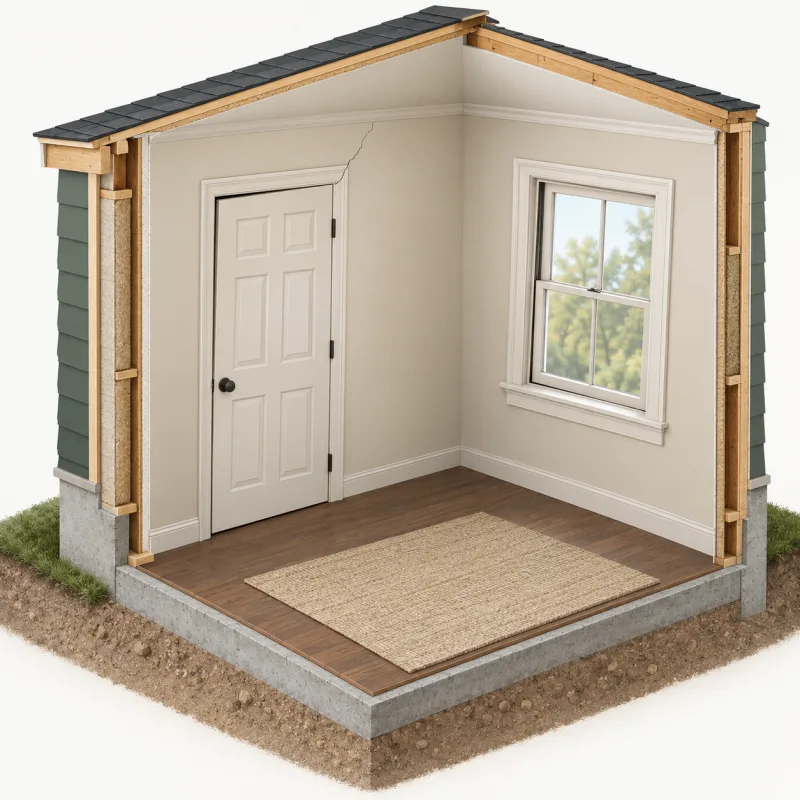
Swollen wood or a shifting frame
The Colorado Geological Survey describes both causes in one place. Doors and windows that stop closing properly are distorted. Heave from swelling soil can do that. So can green wood, meaning lumber that was not fully dried.
Tell the repair company when the sticking began and whether it changes with the seasons. Ask it to check both the door or window and the surrounding frame.
ASCE’s homeowner guide lists sticking doors, sticking windows and cracks above doors and windows as signs of soil movement. It names gaps between frames and walls as an outside sign. It also says the more of these you see, and the more often, the more likely it is that the foundation has shifted.
What to check today
Use your phone camera to record what you find.
- The gap. Close the door and look at the gap around it. Is it even all the way around, or shaped like a wedge?
- The latch. Does the latch meet the strike plate, or hit above or below it? Mark where it hits.
- The hinges. Look for loose screws and tell the company whether tightening them changes how the door closes.
- The wall above. Look for cracks running up from the top corners of the frame.
- Outside. Check the frame from outside. Look for gaps where it meets the brick or siding.
- The ground nearby. Look for water that collects near that wall. The Foundation Performance Association warns that air-conditioner water dumped next to the house can cause uneven movement in one spot.
Write down which doors and windows stick, and the date. Check them again in a month and after the weather changes. A list like this helps the company see what is moving.
How Oklahoma clay moves a door frame
ASCE’s homeowner guide says changes in soil moisture push a foundation up and down. Drought can let part of a house drop. Too much water, from a leak or a sprinkler, can push part of it up. When one corner moves more than the rest, door and window openings lose their square shape.
In Creek County, 37.4% of mapped acres have high or very high shrink-swell soil, by USDA survey estimates. In Pottawatomie County the share is 20.9%. These are county-wide figures, not a test of your lot. Still, they are a good reason to choose a company that works on this clay all the time. The Sapulpa and Shawnee pages cover the local permit steps.
When it points to the foundation
Have a repair company assess the house in these cases:
- several doors or windows started sticking around the same time;
- a door that used to latch now will not;
- new cracks appear above doors or at frame corners;
- the floor near the sticking door feels like it slopes.
The sloping floors page explains how to check a floor. The foundation cracks page shows how to track a crack. For all signs sorted by urgency, see foundation warning signs.
If a sticking door comes with a gas smell, leave the house first. Once you are outside, call the gas company and emergency services.
Repair company first, engineer if needed
Start by scheduling a repair company to look at the sticking openings and nearby damage. Ask for its findings about the movement, the likely cause and any recommended repair. An independent structural engineer makes sense when the cause is unclear, when bids disagree, or when a lender or buyer wants a report. The foundation repair cost page shows what common repairs cost.
Asking for a quote
Send the quote form with the list of doors and windows that stick and when it started. Request an on-site look and an itemized repair price from a local company. Ask for the quote to cover:
- whether the foundation has moved, and where;
- the repair it proposes, if any;
- drainage or water work near the house;
- whether the job needs a permit and the company will handle it, with the fee listed.
Questions to ask a repair company
For a major repair, or if the problem is unclear, will a licensed engineer review the plan?
Engineering guidelines describe an engineer's evaluation as the way to tell cosmetic cracks from structural damage. ASCE Texas Section guidelines (2022)
What is causing the movement, and what will be done about the water?
On shrink–swell clay, keeping soil moisture even around and under the foundation is the main way to reduce movement, so drainage and leaks matter as much as the repair. ASCE Geo-Institute, Living With Shrink/Swell Soils (2022)
Will the plumbing be tested after lifting, and who pays if a leak is found?
Engineering guidelines call for leak tests of water and sewer lines after a foundation is lifted. ASCE Texas Section guidelines (2022)
Will you measure floor levels before and after the repair?
Engineering guidelines call for an elevation survey after the work, which gives you a before-and-after record. ASCE Texas Section guidelines (2022)
Is the warranty in writing, what does it exclude, and does it transfer if I sell the house?
The FTC notes that a warranty won't necessarily cover all situations or repairs and advises getting spoken promises in writing. FTC, Warranties
Does this job need a city permit, and who will get it?
Oklahoma's Construction Industries Board tells homeowners to check whether a permit is needed and to see it before work begins. Oklahoma CIB, Home Repair Tips
Can I get three written estimates for the same plan?
Oklahoma's Construction Industries Board and Emergency Management recommend at least three estimates based on the same specifications. Oklahoma CIB, Home Repair Tips
Frequently asked questions
Should I plane down a door that sticks?
Before removing wood, note the date and where the door rubs. Ask the company assessing the frame whether an adjustment makes sense.
Only one window sticks, and only in summer. Do I need a repair company?
Record when it sticks and take photos of the frame. Request an assessment if other openings start sticking or nearby cracks appear.
Can a door stick because the house is rising, not sinking?
Yes. The Colorado Geological Survey says swelling soil can heave a house and distort door frames. ASCE adds that too much water near the house can make a stable area start to heave.
What does fixing the drainage cost?
Angi lists a drainage system at $2,800–$6,500 as of October 2026. That is a national range. Ask the company to price any drainage work as its own line in the quote.
Sources
- Living With Shrink/Swell Soils — A Homeowners' Guide to Maintenance of Shallow Foundations, Version 2 (2022) (ASCE Geo-Institute)
- Special Publication 14, Home Landscaping and Maintenance on Swelling Soil, 1987 (Colorado Geological Survey)
- Guidelines for the Evaluation and Repair of Residential Foundations, Version 3 (2022) (ASCE Texas Section)
- Drainage Guidelines (Foundation Performance Association, FPA-SC-17-0, 2012)
- Soil Data Access, SSURGO survey data (USDA NRCS)
- How Much Does Foundation Repair Cost? (Angi)