Slab jacking raises a sunken concrete slab. Holes are drilled through it, and material is pumped underneath. In mudjacking the material is a cement slurry, a thick wet mix. In polyurethane lifting it is a two-part foam that expands. Either can bring a low area back up and fill the gap beneath.
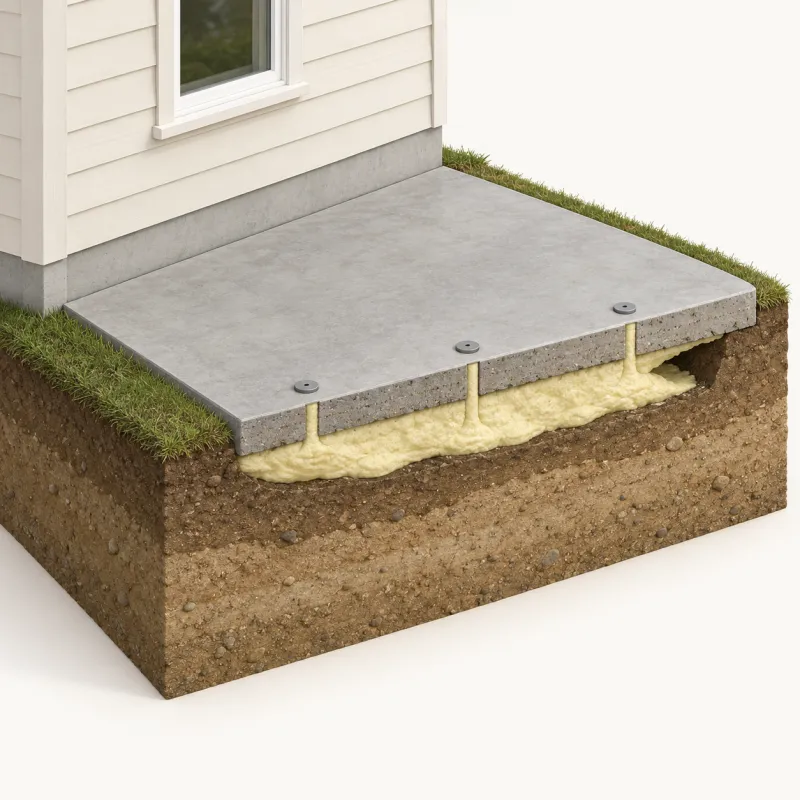
Mudjacking vs. polyurethane foam
Mudjacking. The Foundation Performance Association’s 2004 Houston guide describes it as lifting a foundation “by pressure injecting a slurry composed of sand, fly ash, or topsoil and cement between the slab and the soil.” A 2000 Oregon Department of Transportation report on road slabs explains how it works:
- Holes 2 to 3 inches across are drilled through the concrete.
- Grout is pumped in.
- The pumping pressure controls the lift.
- The grout fills voids mainly near each hole.
Polyurethane foam. Two liquids are injected together under the low area. They react into a rigid foam that expands to several times their volume and pushes the slab up. The Oregon report describes the details:
- the holes are about 5/8 inch;
- the rise is controlled by how fast the liquids go in;
- a string line or laser level tracks the slab, with several small lifts if needed.
The FPA guide notes that afterward the lifted area “will sit on the foam.”
| Mudjacking | Polyurethane foam | |
|---|---|---|
| Material | Sand, fly ash or topsoil with cement | Two-part rigid foam |
| Hole size (Oregon road report) | 2–3 inches | About 5/8 inch |
| How lift is controlled | Pumping pressure | Injection rate |
| National price per sq ft (HomeGuide) | $4–$9 | $8–$25 |
The Oregon report says foam is light, so it should cause less weight-induced settling than grout or mud. Its closed cells should also reduce water getting in underneath. The report also passes on a claim from URETEK, a foam installer: the foam reaches 90% of its strength within 15 minutes. Huntsman’s GEOLIFT 4.0 data sheet gives a sense of the material:
- a free-rise density of about 4 pounds per cubic foot;
- a compressive strength (resistance to crushing) of 58 psi at that density;
- more than 90% closed cells;
- water absorption of 1% or less.
The data sheet also calls for air and slab temperatures above 32°F.
The ASCE Texas Section’s 2022 guideline, written for Texas engineers, lists mudjacking among slab repair methods. It describes mudjacking as adjusting a foundation’s elevation “hydraulically with continuous uniform support.” It separates mudjacking from grouting. Grouting fills under a slab without lifting it much.
How slab jacking behaves on expansive clay
The 2004 FPA guide describes both methods as shallow repairs affected by soil movement. The slab can move again as soil moisture changes. For mudjacking, it names the usual triggers:
- broken sewer or water pipes under the slab;
- trees close to the house;
- extreme seasonal swings;
- poor drainage.
Foam has one clay-specific risk. The guide warns about an overly wet foam mix. Before the foam hardens, water from it can seep into expansive soil and cause local heave. That can leave the floor out of level.
Houses that already have piers call for care. The ASCE Texas guideline says mudjacking can be done over deep piers for long-term support. But it should not be done beneath a pier-supported foundation if the injected soil may swell enough to damage the house.
A sinking footing is a different problem from a sunken slab. Deep support from steel push piers or helical piers is a different kind of repair. Ask the repair company what its floor measurements and other findings suggest about the cause.
Protecting plumbing during a lift
The Houston FPA guide lists these problems during the work:
- Pumping too much material can bulge or crack the slab.
- Very high pressure can cause blowouts.
- Material can enter cracked underground utility lines and partly or fully plug them.
- Mud can be trapped by tree roots or pipes and lift one area unevenly.
The ASCE Texas guideline says water supply and drain lines should be leak-tested after any lifting. It also says lifting is unlikely to leave a foundation perfectly level. Ask the company how it checks the lines under the slab before injecting. Ask too whether the leak test after the lift is in its price.
When slab jacking can make sense
The ASCE Texas guideline says drainage, watering or vegetation changes with monitoring before structural repair “may be a prudent approach.” Ask the company whether that approach fits your house. Whether a sunken area is still moving helps decide the repair. So a few dated photos or measurements are useful to have when the company comes out.
Water is the other half of the job. The 2004 FPA guide links continued movement after repair to poor drainage. So ask whether a leak or drainage problem needs fixing before the lift. FPA’s 2012 Houston drainage guideline recommends full gutters draining into solid underground pipe. That advice is for soils with an effective plasticity index of 35 or greater, a lab measure tied to how much the clay can swell. The guideline also warns about uneven soil pressures from air-conditioner condensate, the water an AC unit drips beside the foundation. If you are still working out whether the movement is serious, our page on foundation warning signs covers what to record first.
What slab jacking costs
Slab lifting is priced by the square foot. So it is not a row in the table below, which covers piers and other foundation work. HomeGuide’s November 2025 national guides give these prices:
- mudjacking: $4–$9 per square foot, with minimum jobs around $300–$700;
- foam lifting: $8–$25 per square foot, with minimum jobs around $300–$700 or more.
For a 1,500-square-foot foundation, HomeGuide gives $6,000–$13,500 for mudjacking and $12,000–$37,500 for foam. The foundation repair cost page has more on reading quotes.
Compare the area covered by each slab-lifting quote. Use the form to ask a local repair company about an on-site assessment, any required permit and an itemized price. Ask for each of these on its own line:
- the square footage to be lifted;
- the material;
- the number of holes;
- the plumbing check before and after.
Foundation repair prices (U.S. cost guides)
The overall range is $250–$30,000.
| Option | Low estimate | High estimate | Notes |
|---|---|---|---|
| Typical foundation repair, total | $2,225 | $8,133 | Angi (updated October 2026); Fixr gives a similar $2,200–$8,200. |
| Crack injection, per crack | $250 | $800 | HomeGuide (2025) and Angi. |
| Steel push pier, per pier | $1,000 | $3,000 | HomeGuide, Angi and Ram Jack cost pages. |
| Helical pier, per pier | $2,000 | $4,000 | HomeGuide (February 2026), Ram Jack; Angi about $3,000. |
| Underpinning, whole job (about 10 piers) | $10,000 | $30,000 | Angi (July 2026) and HomeGuide. |
| Drainage system | $2,800 | $6,500 | Angi (October 2026). |
| Structural engineer foundation inspection | $300 | $750 | HomeGuide (February 2026); Angi lists $300–$1,000 for a structural report. |
Usually included
- National averages from Angi, HomeGuide, Fixr and Ram Jack
Often extra
- City building permit, if your city requires one for the work
- Landscaping, interior drywall and trim repair after the foundation is stabilized
Frequently asked questions
Is polyurethane foam better than mudjacking?
Foam is lighter and needs smaller holes: about 5/8 inch against 2 to 3 inches in a 2000 Oregon road study. That study expected foam to cause less weight-induced settling. Foam also costs more per square foot in national guides. Ask the company to compare the two materials for your slab and soil.
Will slab jacking stop my foundation from moving?
Have the company explain how the lift fits into its plan for soil moisture. Ask what it will do about leaks and drainage as part of the job.
Can slab jacking be done on a house that already has piers?
The ASCE Texas Section guideline, prepared for Texas engineers, describes grouting or mudjacking over deep piers for long-term support. Ask an engineer to review the existing pier layout and expected soil swelling before choosing a lift.
How much does slab jacking cost?
It is priced by area. HomeGuide gives $4–$9 per square foot for mudjacking and $8–$25 per square foot for foam. Minimum jobs run around $300–$700 for mudjacking and $300–$700 or more for foam. For a whole 1,500-square-foot foundation, HomeGuide gives $6,000–$13,500 for mudjacking and $12,000–$37,500 for foam.
Can the material get into my pipes?
Ask how the company will check lines beneath the slab and whether its price includes leak tests. Have it describe what it will do if those checks find a damaged line.
Sources
- Post Foundation Repair Performance of Residential and Other Low-Rise Buildings on Expansive Soils (Foundation Performance Association, FPA-RC-01-0, 2004)
- Guidelines for the Evaluation and Repair of Residential Foundations (ASCE Texas Section, Version 3, 2022)
- Injected Polyurethane Slab Jacking, Interim Report SPR 306-261, FHWA-OR-EF-01-03, September 2000 (Oregon DOT / FHWA)
- GEOLIFT 4.0 Technical Data Sheet, rev. 12.09.20 (Huntsman Building Solutions)
- Drainage Guidelines (Foundation Performance Association, FPA-SC-17-0, 2012)
- How Much Does Mudjacking Cost? (HomeGuide, 2026 guide; November 2025)
- How Much Does Polyjacking Cost? (HomeGuide, 2026 guide; November 2025)
- How Much Does Foundation Repair Cost? (Angi)
- How Much Does Underpinning a Foundation Cost? (Angi)
- Foundation Repair Cost (HomeGuide)
- Helical Piers Cost (HomeGuide)
- Foundation Crack Repair Cost (HomeGuide)
- Foundation Inspection Cost (HomeGuide)
- Cost to Repair a Foundation (Fixr)
- Cost of Foundation Repair (Ram Jack)