Garfield County leads these 20 Oklahoma counties, with about 55% of mapped land rated high or very high for soil shrink-swell. Washington, Noble, Rogers, Tulsa and Wagoner follow at about 39% to 43%, while Custer, Texas and Beckham have the least.
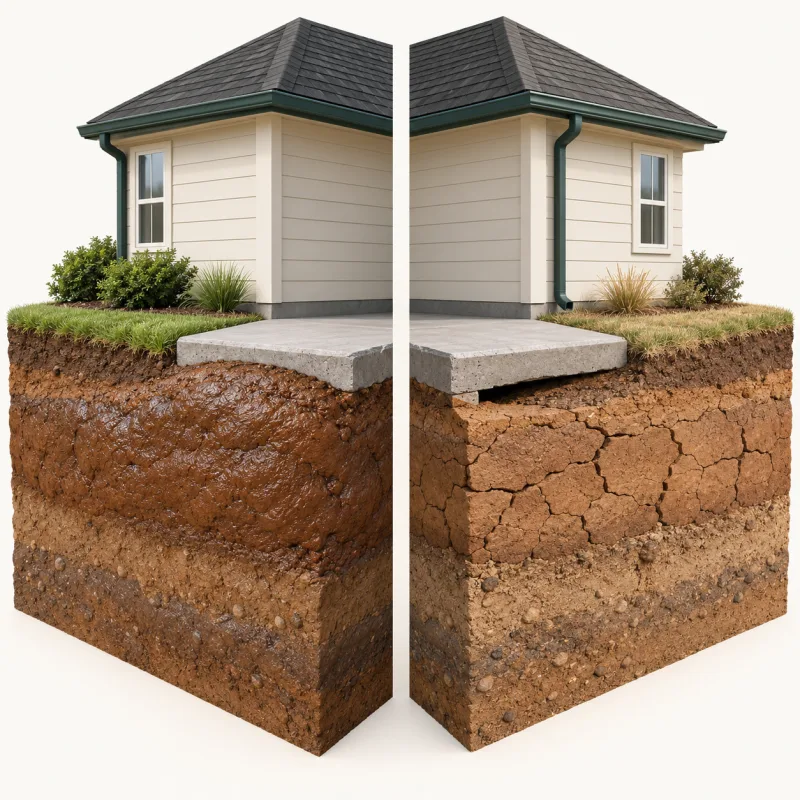
“Shrink-swell” means the clay takes on water and swells, then shrinks as it dries. This can push a foundation up and let it drop as moisture changes.
Shrink-swell clay by county
USDA soil surveys rate each soil by how much it swells. The first percentage column below shows the share of each county’s mapped land where the main soil is rated high or very high, meaning it swells by 6% or more. USDA says damage to buildings can begin one class lower, at moderate. The second percentage column includes moderate soil too. It is calculated from the mapped acres in those three classes.
| County | High or very high | Moderate or higher |
|---|---|---|
| Garfield | 55.0% | 82.4% |
| Washington | 43.1% | 93.9% |
| Noble | 42.8% | 92.2% |
| Rogers | 39.9% | 77.8% |
| Tulsa | 39.3% | 73.1% |
| Wagoner | 38.7% | 67.3% |
| Creek | 37.4% | 50.7% |
| Seminole | 36.9% | 56.7% |
| Comanche | 34.6% | 78.7% |
| Payne | 32.1% | 58.7% |
| Okmulgee | 31.2% | 62.0% |
| Jackson | 28.4% | 73.0% |
| Oklahoma | 22.7% | 35.3% |
| Canadian | 21.7% | 63.0% |
| Pottawatomie | 20.9% | 38.0% |
| Logan | 20.4% | 45.5% |
| Cleveland | 19.8% | 46.3% |
| Beckham | 9.8% | 30.8% |
| Texas | 6.7% | 63.6% |
| Custer | 0.0% | 44.9% |
Including moderate soil changes the picture in places. Washington and Noble have moderate or stronger clay under more than nine-tenths of their land. Texas County ranks near the bottom on high-rated clay but has moderate soil across most of it. The figures cover whole counties, rural land included, so they describe the area and are not a test of your lot.
What Tulsa’s own hazard plan says
The City of Tulsa’s 2024 hazard mitigation plan says the city sits on soils with very high expansion potential. It names large areas of central and east Tulsa, and many higher spots, as moderate to high. Lowlands along the river and other waterways generally have low shrink-swell soil.
The plan counts 373 Tulsa buildings on soil with very high shrink-swell potential, worth an estimated $191 million. It also lists the signs of soil-related damage:
- sticking doors;
- uneven floors;
- cracks in foundations, floors, walls, ceilings and windows.
“It does not take much movement to damage buildings,” the plan says. The plan also links water line breaks during extreme heat and drought to expansive soils.
Wagoner and Oklahoma County: soil changes across short distances
About 39% of Wagoner County’s land is rated high or very high, yet the City of Wagoner’s 2020 hazard plan maps most of the city in the low shrink-swell category. The plan adds that clay damages foundations slowly over time, not all at once like a tornado.
Oklahoma County’s 2024 plan shows the same kind of variation. It lists expansive soil as a hazard for Bethany, Edmond and Del City. It says clay makes expansive soil common in the western part of the county. For Choctaw, the plan says the USDA soil map shows none. That is one reason a repair company that already works in your town is worth more than a county average.
Why this clay moves a foundation
ASCE’s homeowner guide says shrink-swell clay moves foundations up and down as soil moisture changes. Keeping that moisture even around and under the house is the single best protection. Several everyday things make it uneven:
- Drought. Long dry spells dry the soil unevenly, and the foundation can drop.
- Overwatering. Too much water can make a stable area start to heave.
- Leaks. A leaking water or sewer line soaks one spot.
- Roof runoff. Water ponding by the wall can lift that section.
- Trees. Roots next to or under the house can dry out the soil.
ASCE suggests a yearly look at the ground within 10 feet of the house. It should slope away at least 3 inches over 5 feet. Downspouts should empty at least 5 feet out. In a drought, follow city watering bans. Under tight watering restrictions, ASCE suggests considering soaker hoses 18 inches from the foundation. It recommends more water on the south and west sides, within local watering rules.
The foundation warning signs guide sorts cracks and sticking doors by how soon to act. The Oklahoma foundation repair page covers local permit rules.
Getting a local look at your house
If you see cracks or sticking doors, request an on-site assessment from a local repair company through the quote form. Ask for an itemized price based on what it finds. Ask it to put these in writing:
- what is moving and why;
- the repair it proposes;
- any drainage or watering changes;
- whether the repair needs a permit and what the fee would be.
The foundation repair cost guide shows what the common repairs cost.
Frequently asked questions
What is the difference between clay rated high and very high?
It is how much the soil swells. USDA rates soil that swells by 6% to 8.9% as high and 9% or more as very high. Moderate is 3% to 5.9%. USDA says shrinking and swelling can damage buildings from the moderate class up.
Why does Custer County show 0% high or very high?
None of its main soils reach the high class. About 45% of its mapped land is still rated moderate, which USDA counts as able to damage buildings.
Is clay soil only a problem during droughts?
No. Tulsa's 2024 hazard plan ties the damage to cycles of drought and heavy rain. ASCE adds that overwatering, leaks and roof runoff can make one part of the soil swell while another dries.
Sources
- USDA NRCS Soil Data Access (SSURGO)
- National Soil Survey Handbook, Part 618, section 618.42 Linear Extensibility Percent (USDA NRCS)
- 2024 Hazard Mitigation Plan (City of Tulsa)
- City of Wagoner, Oklahoma — Multi-Hazard Mitigation Plan – 2020
- Oklahoma County Hazard Mitigation Plan, 2024 Update
- Living With Shrink/Swell Soils — A Homeowners' Guide to Maintenance of Shallow Foundations, Version 2 (2022) (ASCE Geo-Institute)